
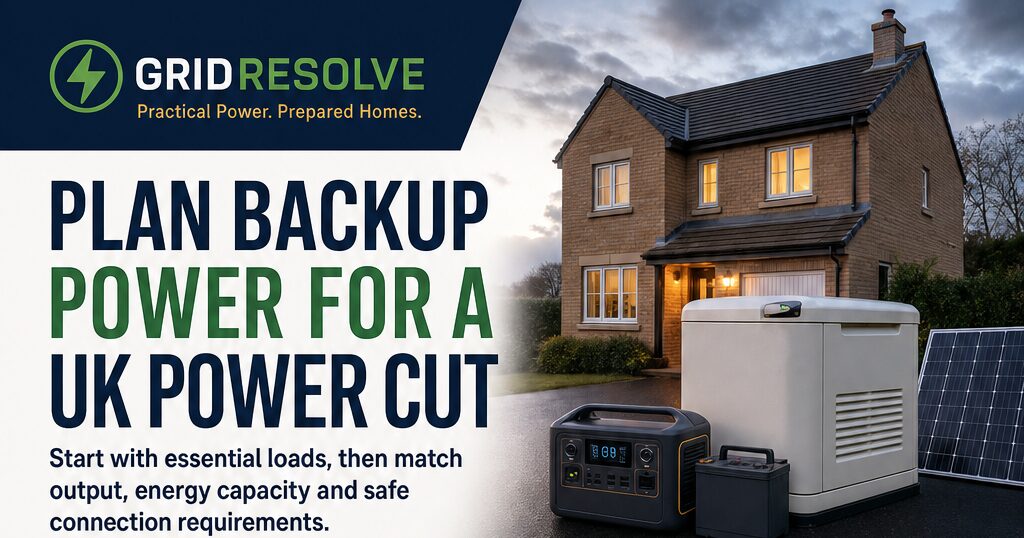

A power cut rarely arrives at a convenient time. The lights go out, the broadband router drops, the freezer starts warming and, in colder weather, the heating controls may stop responding. Most households do not need to keep everything running, but they may want a dependable way to power a short list of essentials.
That list might include a fridge-freezer, boiler controls, a few lamps, the internet router and phones. Keeping those loads running is a different challenge from powering an electric cooker, immersion heater or whole house. The right backup route depends on how often outages happen, how long they last and whether you need portable power or an installed system.
Start by defining your essential loads
Before choosing equipment, decide what “essential” means in your home. A useful list normally separates appliances into three groups:
- Must run: perhaps a fridge-freezer, heating controls, alarm system, router or selected lighting.
- Useful if available: laptops, televisions, chargers and a low-power fan.
- Comfort loads: kettles, microwaves, hairdryers, washing machines, tumble dryers and electric heaters.
This matters because high-power appliances can use more electricity than several smaller loads combined. A kettle may be needed only for a few minutes, while a router may draw relatively little power but be useful throughout the outage. You may choose to boil water once rather than size a backup system to run the kettle repeatedly.
Do not assume that a device with a low average consumption has no starting demand. Fridges, freezers, pumps and other equipment with motors or compressors can briefly draw more power when starting. Check the appliance data plate, manual or manufacturer specification for running power and, where provided, starting or surge requirements.
The main backup-power options for a UK home
Portable power stations
A portable power station is a battery system with built-in outlets and charging electronics. It can be kept indoors when permitted by its instructions, moved between rooms and recharged from the mains. Some models can also accept solar input or other charging sources.
This route suits people who want a relatively simple, non-permanent solution for selected appliances. It can be useful for keeping communications, lighting and small electronics available, and a suitably specified unit may support some refrigeration or heating-control loads.
Check more than the headline battery capacity. The continuous AC output must cover the appliances you intend to use, while the surge capability must be suitable for starting loads. The socket type, waveform, earth arrangements, charging time, operating temperature range and manufacturer restrictions can also affect compatibility. These details vary by model; they are not assumptions to make from capacity alone.
Installed home batteries
An installed battery can provide a more integrated form of backup, particularly where the home already has solar panels or there is a preference for equipment that stays in one place. Depending on the system design, it may support a designated backup circuit rather than every circuit in the property.
Installation is not a simple matter of plugging a large battery into a wall socket. The design needs to account for the property’s electrical system, intended loads, location, ventilation and safe isolation. A competent, appropriately qualified installer should assess the installation and explain which circuits will remain powered during an outage. Ask what happens when the battery is empty and how the system behaves when the grid supply returns.
Existing solar does not automatically mean the home will operate during a grid outage. Backup operation depends on the inverter, battery, controls and installation design. Ask the installer to describe the outage behaviour rather than assuming that solar panels alone provide emergency power.
Petrol or other combustion generators
A generator can provide substantial power for longer outages, subject to fuel availability, maintenance and safe operation. It may be considered where outages are infrequent but extended, or where the required load is beyond the practical output of a small battery.
Combustion generators must be operated outdoors, in the open air, and never inside a home, garage, shed, basement, conservatory or another enclosed or partially enclosed space. Carbon monoxide is a serious risk. Keep the generator away from doors, windows and ventilation openings, follow the manufacturer’s siting instructions and consider how exhaust and noise could affect neighbours. Do not bring a running generator indoors to shelter it from rain; use only arrangements approved for that equipment.
A generator must not be connected to a home by improvised wiring or by feeding a socket. Backfeeding can put people working on the electricity network at risk and can damage equipment. Connecting a generator to fixed household circuits requires suitable equipment and professional design and installation. Fuel storage, starting procedures, servicing and local requirements also need attention.
Solar panels
Solar can reduce reliance on stored or fuel-based energy, but panels are not by themselves a guaranteed power-cut solution. They produce variable power, and a grid-connected solar inverter will commonly shut down when the grid is absent unless the system is specifically designed to provide safe islanded backup.
Solar is therefore best considered as part of a wider system where the inverter, battery and backup controls are compatible. Ask what can run in poor weather, whether the battery can recharge during an outage and which circuits are supported. Treat manufacturer documentation and the installer’s design as the source of truth.
EV-based backup
Some electric vehicles and charging systems can supply power to equipment or a property, but this is not a universal feature. Vehicle-to-load and vehicle-to-home arrangements depend on the vehicle, charger, software, connection equipment and the home’s electrical design.
If you already own an EV, it is worth asking the vehicle manufacturer and a suitably qualified installer whether backup use is supported. Do not assume that an ordinary charging cable can provide a safe way to energise household circuits.
Estimate the power output you need
Power is measured in watts (W) or kilowatts (kW). It describes how much equipment can run at one time. Energy is measured in watt-hours (Wh) or kilowatt-hours (kWh). It describes how long a battery can supply a load.
Make a table of the appliances you expect to use together. Record each appliance’s stated running power, then add those figures. Next, check for starting or surge requirements, especially for compressors, pumps and motors. The backup equipment should have enough continuous output for the combined running load and enough short-term capability for starting events.
As a simple planning example, a group of appliances with a combined running demand of 300 W used continuously for four hours would require 1,200 Wh before losses. That is an energy calculation, not a promise of runtime. In practice, the battery may not expose all its nominal capacity, and the inverter and other electronics consume energy. The manufacturer may also specify a minimum reserve or limit certain operating modes.
For a rough battery estimate:
required battery energy ≈ average load in watts × operating time in hours ÷ overall efficiency
Use the expected average load, not simply the highest nameplate figure, if an appliance cycles on and off. At the same time, do not reduce the estimate so far that a fridge, freezer or pump cannot start. Allow a sensible margin and compare your calculation with the manufacturer’s usable-capacity figure.
Generator sizing uses output rather than battery energy. Compare the generator’s continuous or rated output with the running load, then check its stated starting capability. Some generators deliver less in particular conditions, and the actual fuel use, runtime and noise depend on the model, load and environment.
Plan the connection before an outage
The least complicated arrangement is often to power individual appliances directly from a portable unit, provided the plugs, leads and load are suitable and the manufacturer permits that use. Keep cables tidy and avoid creating trip hazards, especially around entrances and stairs.
A permanent backup arrangement may supply only selected circuits, such as refrigeration, lighting or heating controls. That can be more efficient than attempting to back up the entire property, but it requires proper assessment. Never alter a consumer unit, install a changeover arrangement or connect a generator to fixed wiring as a DIY project. Use an appropriately qualified electrical professional and ask for clear instructions on what is and is not backed up.
Keep battery equipment dry, stable and clear of heat sources. Follow the manual for ventilation, charging, storage and inspection. Do not use damaged cables, swollen batteries or equipment showing signs of overheating. For any device used to support a medical or life-sustaining function, follow the device manufacturer’s guidance and seek advice from the relevant clinical and qualified technical professionals rather than relying on a general backup-power plan.
Choose according to the outage you are planning for
A useful decision framework is to score each option against six questions:
- How often do cuts occur? Occasional short interruptions may not justify a permanent installation.
- How long might you need power? A battery can cover a defined load for a defined period; a generator may be considered for longer operation, with fuel and maintenance implications.
- Do you need portability? A portable unit can serve different rooms or locations, while installed equipment stays with the property.
- What is your realistic budget? Compare the complete system, including any professional work, compatible accessories, servicing and safe fuel storage where relevant.
- How much maintenance will you accept? Batteries, generators and solar equipment each have different inspection, storage and replacement considerations.
- Do you already own solar or an EV? Existing equipment may create useful options, but only if the specifications and backup controls are compatible.
For many households, the best first step is not buying the largest available system. It is measuring or checking the likely loads, deciding how many hours of cover are useful and identifying whether any appliance has a difficult starting demand. That process narrows the choice and reduces the risk of paying for capacity you cannot use safely.
Frequently Asked Questions
What should I keep running during a UK power cut?
Prioritise the appliances that protect food, communications, basic lighting and essential household functions. A fridge-freezer, router, phone chargers and selected lights are common choices. Heating controls or a boiler pump may also matter, but check their electrical requirements and connection method. Avoid treating medical equipment as an ordinary household load: follow its manufacturer’s and clinical guidance.
How big a battery do I need for a power cut?
Estimate the average wattage of the appliances you want to run, multiply it by the number of hours and allow for conversion losses and usable-capacity limits. Then check continuous output and surge capability separately. The appliance data plates and the battery manufacturer’s usable-energy and output specifications are more useful than a generic runtime claim.
Can I run a petrol generator in my garage with the door open?
No. A combustion generator should not be operated in a garage or other enclosed or partially enclosed space, even with a door open. Carbon monoxide can accumulate quickly. Operate it outdoors in accordance with the manufacturer’s siting instructions, and use professional help for any connection to household circuits.
Will my solar panels work during a power cut?
Not necessarily. Many grid-connected systems shut down when the grid supply is unavailable. Continued operation requires compatible backup controls, inverter equipment and, commonly, stored energy. Ask the system manufacturer or installer which circuits are supported and how the system behaves during an outage before relying on it.
To make a practical plan, write down your essential appliances tonight, copy their running and starting figures from the data plates or manuals, and decide how many hours of cover you actually need. Take that list to the equipment manufacturer or a suitably qualified installer before choosing a system.