
Can an electric vehicle power your home during a power cut, run an individual appliance or export electricity to the grid? Sometimes—but those are different functions, requiring different equipment and permissions.
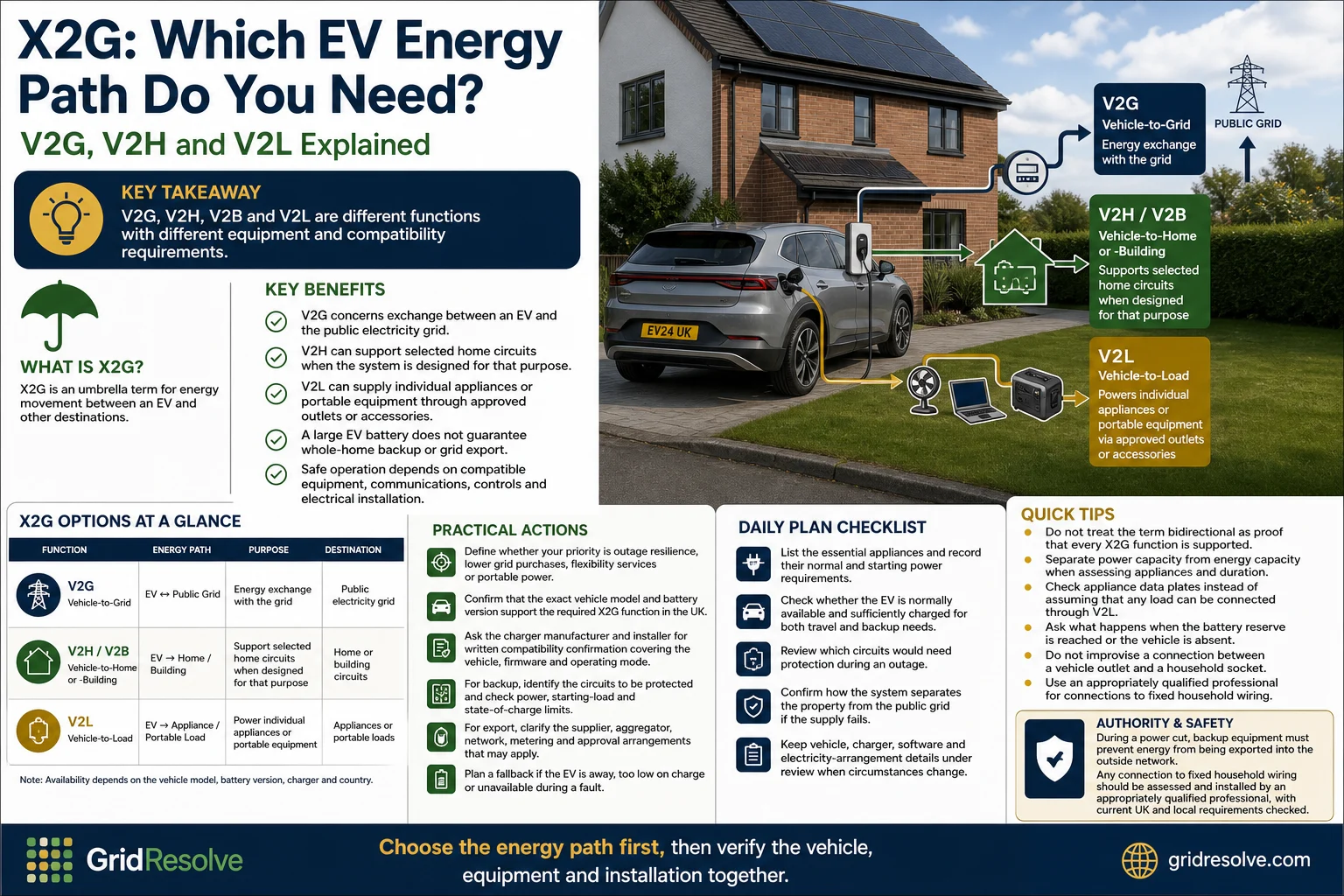
The label everything-to-grid, or X2G, is an umbrella term for systems that move energy between an electric vehicle, a building, appliances and the electricity grid. The better-known terms—V2G, V2H, V2B and V2L—describe particular energy paths. They are related, but they are not interchangeable.
For a UK household considering an EV as backup power, the key question is not simply whether the vehicle has a large battery. The vehicle, bidirectional charger, communications system, home wiring, electricity arrangements and installation all need to support the intended use.
What does everything-to-grid mean?
X2G describes bidirectional energy use between an electric vehicle and one or more destinations. A conventional EV charging system sends electricity one way: from the grid to the car. An X2G arrangement can also send some of the battery’s stored energy outwards, subject to the vehicle and equipment’s limits.
The “everything” in X2G is deliberately broad. It can include:
- the electricity grid;
- a home or other building;
- individual appliances and tools; and
- energy-management software or a charging network.
In practice, X2G is more of a family name than a single product category. A system marketed as bidirectional may support one energy path but not another. Check exactly what the manufacturer means before treating an EV as a backup battery or an export asset.
V2G, V2H, V2B and V2L: the difference
Vehicle-to-grid (V2G)
V2G allows an EV to exchange energy with the public electricity grid. The vehicle may charge when electricity is available or when a household’s arrangement makes charging attractive, then export energy at an approved time. The system can potentially support grid balancing or other flexibility services, but participation depends on the relevant electricity supplier, aggregator, market arrangement and technical setup.
V2G is not the same as simply plugging a car into a socket. Exporting to the UK grid requires equipment and controls that manage voltage, frequency, protection and communication. The vehicle also needs to be approved for bidirectional operation with the charger being used.
Vehicle-to-home (V2H)
V2H sends energy from the EV to the home. It may reduce the amount of electricity bought from the grid at selected times, or provide power when the grid supply is unavailable.
There is a crucial distinction between those two uses. Supporting a home while the grid is live is different from keeping circuits energised during an outage. During a power cut, the home must be separated from the public network in a controlled way so that the backup supply does not energise a network that line workers may believe is dead. A suitable system may therefore need isolation, changeover and protection equipment as part of a professionally designed installation.
Vehicle-to-building (V2B)
V2B is similar to V2H, but the building could be a workplace, school, depot or commercial premises rather than a house. The electrical demand may be larger and the energy-management rules more involved. A building can also have several vehicles arriving and leaving at different times, so available energy is less predictable than the battery’s nominal capacity suggests.
Vehicle-to-load (V2L)
V2L supplies a load directly from the vehicle, commonly through dedicated outlets or an accessory supplied for that purpose. It may be useful for portable equipment, chargers or selected appliances away from the home’s fixed wiring.
V2L is usually the most straightforward concept, but it is not automatically a whole-home backup system and it is not the same as grid export. The available output may be limited, and motors, compressors and heating elements can have demanding starting or running loads. Check the vehicle’s published output rating and the appliance data plate rather than assuming that any device can be connected.
Why a large EV battery is not enough
Battery size is only one part of the calculation. A vehicle might store substantial energy, but that does not mean all of it is available for export, backup or normal driving. Usable energy is affected by the vehicle’s battery-management limits, the reserve kept for driving, temperature, age and conversion losses.
Power and energy also describe different limits. Power, measured in watts or kilowatts, determines what can run at one time. Energy, measured in watt-hours or kilowatt-hours, relates to how long a load can be supplied. A high-power kettle may be manageable for a short period, while a low-power router could run for much longer. A fridge-freezer or pump can have a brief starting demand that is higher than its normal running load.
For an outage plan, list the appliances that matter and check their running and starting requirements. The existing UK home backup power guide covers the wider process of identifying essential loads. An EV-based system still needs that same load planning, even if the battery appears generously sized.
The compatibility chain
Bidirectional energy use works only when several links in the chain agree with one another.
- Vehicle: The EV must support the relevant function—V2G, V2H, V2B or V2L—and permit it in the market where it is being used.
- Charger or power-conversion equipment: A standard one-way charger may not be able to send energy back. A bidirectional unit must be compatible with the vehicle and designed for the intended connection.
- Communications: The vehicle, charger, energy-management platform and sometimes an electricity provider may need to exchange data. Software support can be as important as the hardware.
- Home electrical system: Whole-home or selected-circuit backup requires a properly designed connection to the building’s electrical installation. The equipment must control what is energised and respond safely when the grid supply changes.
- Electricity arrangements: Grid export and flexibility services may involve an electricity supplier, aggregator or network process. Availability and terms can change, so confirm the current position rather than relying on a generic X2G claim.
Compatibility can be narrower than a product advertisement suggests. A vehicle may offer V2L but not V2H. A charger may be technically bidirectional but not supported by a particular car or software platform. A home may have the right equipment but no arrangement for exporting energy. Ask for a written compatibility statement covering the exact vehicle, charger, firmware, electrical connection and intended operating mode.
What happens during a UK power cut?
V2G is primarily about interaction with the public grid, whereas backup operation is about safely replacing that supply for a defined set of circuits. If the network fails, a V2H system must detect the condition and prevent the EV from exporting into the outside network. It may then supply a protected part of the property, or—where the system is designed and approved for it—the wider installation.
That does not guarantee that every appliance will run. The inverter’s maximum power, the selected circuits, the EV’s state of charge and the home’s demand all matter. Electric showers, immersion heaters, ovens, heat pumps and other substantial loads can quickly use available power. Starting loads from compressors and pumps also need consideration.
Do not attempt to create backup by improvising a connection between a vehicle outlet and a household socket, or by modifying fixed wiring. Backfeeding can put people at risk and damage equipment. Any connection to a property’s fixed electrical installation should be assessed and installed by an appropriately qualified professional, with the current UK and local requirements checked at the planning stage.
UK practical constraints
The UK is not one single X2G marketplace. The route from a vehicle battery to the grid can involve the electricity supplier, a flexibility-service provider, the local distribution network operator and the equipment manufacturers. Export arrangements, technical approval, metering and payment structures may differ and may change over time.
Interoperability is another practical issue. A system might need specific communications protocols, an account with a service provider or a particular software version. If you change vehicle, charger or tariff, the original arrangement may not continue in exactly the same form.
Installation conditions matter too. The charger location, cable route, consumer-unit capacity, earthing and protection arrangements should be reviewed as part of the design. For a home that needs resilience, ask the installer to explain which circuits are backed up, the maximum continuous and short-duration output, what happens when the battery reserve is reached and how the system behaves when the vehicle is absent.
Benefits and trade-offs
An EV can provide a useful source of stored energy without requiring a separate stationary battery. V2H may reduce dependence on the grid at selected times, while V2G could let a willing owner participate in flexibility services. V2L can be convenient for occasional portable power.
There are trade-offs. Every exported kilowatt-hour passes through conversion equipment, and energy use can contribute to battery cycling. The effect on battery ageing depends on the battery chemistry, operating window, temperature, charging profile and manufacturer limits; it should not be reduced to a universal mileage or lifespan penalty.
Availability is just as important as capacity. The EV may be away from home, charging for a journey, reserved at a minimum state of charge or unavailable because the service or communications link has failed. A car that is usually present may still be an unreliable sole backup source for an unexpected outage.
There is also a convenience cost. A system may schedule charging or export around your needs, but the owner must still have enough charge for planned travel. Decide whether your priority is emergency resilience, lower grid purchases, participation in flexibility services or portable power. The best technical option depends on that priority.
Questions to ask before choosing an X2G system
Ask the vehicle manufacturer whether the exact model and battery version support the function you want in the UK. Then ask the charger manufacturer and installer to confirm compatibility rather than relying on the phrase “bidirectional charging”. Clarify whether the system supports live-grid energy management, outage backup, or both.
For backup, request a clear description of the protected circuits and operating limits. For export, check who manages the service, what approvals or metering may be needed and what happens if you change supplier or vehicle. Finally, consider a fallback plan if the EV is away, too low on charge or unavailable during a fault.
Frequently Asked Questions
Is X2G the same as V2G?
No. X2G is a broad label for energy moving between an EV and destinations such as the grid, a home, a building or individual loads. V2G specifically means vehicle-to-grid. V2H, V2B and V2L describe different destinations and operating arrangements.
Can any electric vehicle power a house during a power cut?
No. The vehicle must support an appropriate output function, and the charger, control equipment and property installation must be compatible. A safe outage system also needs to manage isolation from the public grid. Check the exact vehicle and charger documentation and use a suitably qualified installer for fixed electrical work.
Does V2L export electricity to the UK grid?
Normally, V2L is intended to supply connected loads through the vehicle’s outlets or an approved accessory. It should not be treated as permission or equipment for grid export. Exporting energy requires a system designed for that purpose and an appropriate UK electricity arrangement.
The practical next step is to write down your intended use—portable loads, selected home circuits, whole-building support or grid services—then obtain compatibility information for the exact EV, charger and installation before making a purchase.