

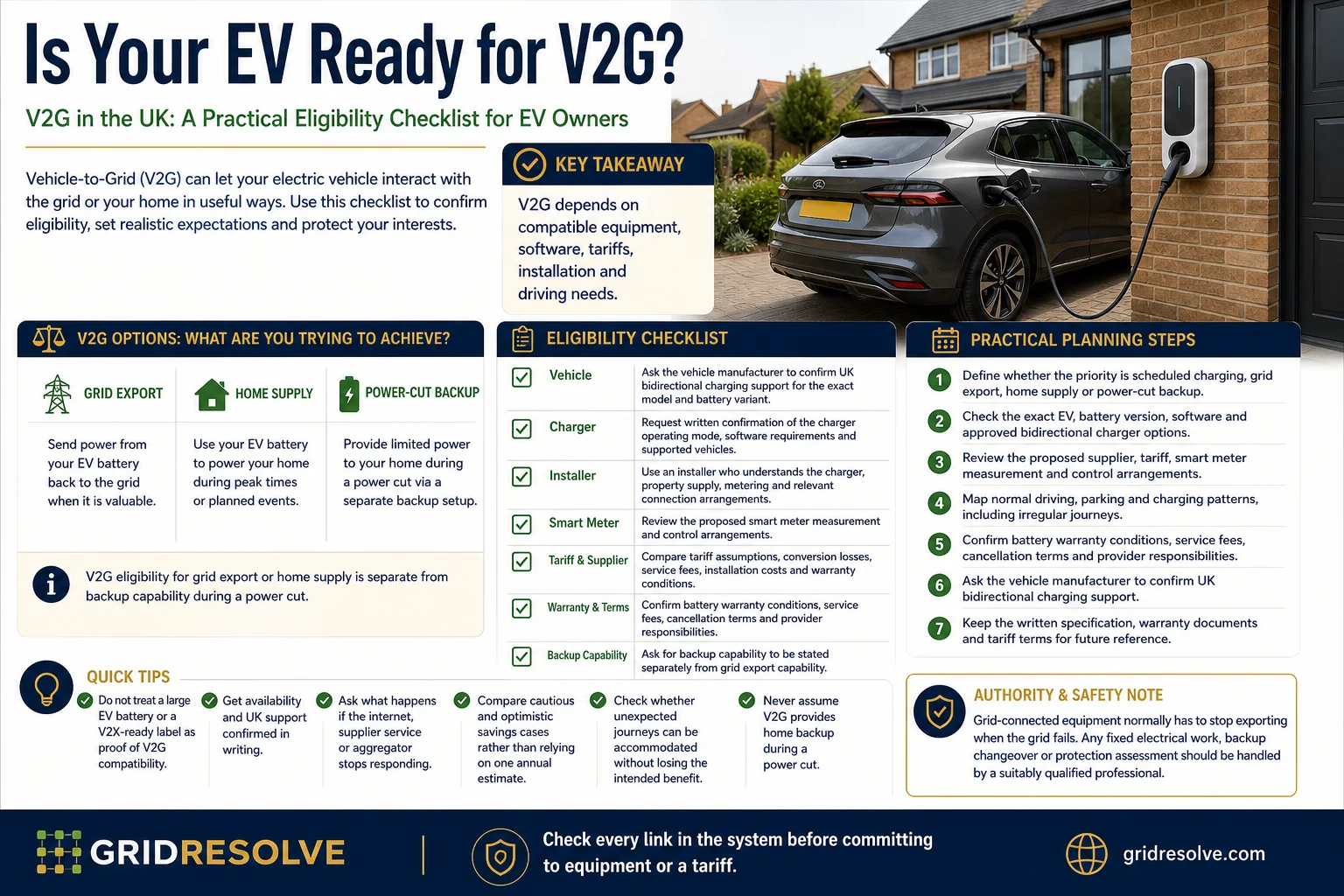
You have an electric car on the drive, a smart meter by the front door and an electricity tariff that changes during the day. It is tempting to see the EV battery as a way to reduce bills—or even keep the house running during an outage.
That may be possible, but buying a bidirectional charger is not the starting point. V2G in the UK depends on a chain of compatible equipment, software, electricity arrangements and installation requirements. If one link does not support the intended service, the project may be limited to ordinary one-way charging.
Use this checklist before you commit to equipment or a new tariff. It is designed to help you establish whether V2G is workable for your particular EV, home and driving routine.
1. Confirm what you want the system to do
Start with the outcome rather than the product name. Do you want to charge the car when electricity is cheaper and discharge it at another time? Are you interested in exporting energy to the grid? Or are you mainly looking for power during a power cut?
These are not automatically the same service. A vehicle, charger and tariff may support scheduled charging and grid export without supporting backup power for the house. Conversely, an arrangement designed to supply selected home circuits may not be approved or configured for export.
If the terminology is unclear, GridResolve’s guide to V2G, V2H and V2L in the UK explains the different energy paths. For this checklist, keep asking one question: what exact function is being offered, and what equipment enables it?
2. Check the vehicle, not just the battery size
A large EV battery does not by itself make a vehicle V2G-compatible. The car must support bidirectional energy transfer through a compatible charging system, and the manufacturer may restrict which chargers, software platforms or markets can be used.
Check the following with the vehicle manufacturer, dealer or an approved charging partner:
- Whether the exact model and battery variant supports bidirectional charging.
- Whether support applies in the UK, rather than only in another market.
- Which bidirectional charger models are approved or supported.
- Whether a software update, connected service or manufacturer account is required.
- Whether the vehicle must be enrolled in a particular energy-management or V2G programme.
- Whether the manufacturer places conditions on minimum state of charge, departure times or discharge use.
Do not rely on a sales description that says “V2X-ready” without asking which direction of energy flow is available. A vehicle might support a form of vehicle-to-load use while not supporting grid-connected V2G. Compatibility can also vary between model years, battery chemistries and regional versions.
3. Establish whether a suitable bidirectional charger is actually available
Even a compatible vehicle needs compatible hardware. A standard home EV charge point normally sends electricity to the car. V2G requires a bidirectional charger and a control system capable of managing the exchange safely and within the relevant operating limits.
Ask the supplier for the complete system specification, not just the charger’s headline feature list. In particular, clarify:
- Which vehicles the charger supports today.
- Whether it can export to the grid, supply a home, or do both.
- Whether the system remains usable as an ordinary charger if the V2G service is unavailable.
- What communications connection and software subscriptions are required.
- How charging and discharging schedules are set, overridden and monitored.
- What happens if the internet connection, supplier service or aggregator platform stops responding.
Availability is a practical issue in its own right. A product may have been announced, demonstrated or offered through a limited programme without being generally available for your vehicle and postcode. Get written confirmation of the equipment being supplied, its supported operating mode and the route for software and warranty support.
4. Use an installer who understands the whole system
V2G is not simply a conventional charge-point installation with a different app. The installer needs to understand the bidirectional charger, the property’s supply, metering and protection arrangements, and any export or connection process that applies.
Before accepting a quotation, ask:
- What relevant qualifications, authorisations or manufacturer training the installer holds.
- Who is responsible for confirming compatibility between the vehicle, charger and electricity arrangements.
- Whether the quotation includes commissioning, software enrolment and handover.
- Whether any distribution-network or supplier communication is required, and who will manage it.
- What information you will receive about export limits, isolation, fault handling and maintenance.
Do not attempt to modify fixed wiring, the consumer unit or protection equipment yourself. A qualified installer must assess and carry out any mains electrical work, and you should check the current requirements that apply to your property and proposed system.
5. Check the smart meter and electricity-supplier arrangements
A smart meter can be an important part of a flexible charging and export arrangement, but having one does not guarantee that V2G will work. The meter, supplier, tariff and control platform must all support the way electricity will be measured and settled.
Ask your current or prospective supplier:
- Whether it supports the proposed V2G or export arrangement.
- How imported and exported electricity will be measured and credited.
- Whether you need a particular tariff, contract or aggregation service.
- Whether the tariff has time windows, minimum terms, exit charges or other conditions.
- How the system handles missed schedules, communications failures and manual charging.
- Whether changing supplier would affect your access to the V2G service.
Export arrangements can involve more than simply sending energy through the meter. The supplier, charger provider and any flexibility-service operator may each have a role. Ask who pays you, who controls the charging schedule and who owns the customer relationship if the service is provided through a third party.
Keep records of the tariff’s import rates, export credit method, standing charge and contract terms. Rates can change, and a tariff that looks attractive under one schedule may be less useful if your driving pattern forces you to charge at other times.
6. Model your routine before estimating savings
V2G value depends on repeated timing opportunities, not simply on the amount of energy stored in the car. A basic assessment should compare your likely charging and discharging schedule with the energy you actually need for driving.
Write down:
- When the car is normally at home and connected.
- How much energy you need for typical journeys.
- The minimum state of charge you want before leaving.
- How often you could allow the car to discharge.
- Whether your household demand is concentrated in particular periods.
- What happens during holidays, irregular shifts or unexpectedly long journeys.
Then compare the potential benefit from buying or avoiding electricity at different times with the energy lost during charging and discharging. Conversion losses, charging limits and reserve settings reduce the energy that can be shifted. You may also need to charge at a less favourable time to guarantee the next journey.
Do not treat a quoted annual saving as guaranteed. It may assume a particular tariff, number of connected hours, battery state of charge and level of participation in a flexibility programme. Ask for the assumptions behind the estimate and calculate a cautious case as well as an optimistic one.
Include the full cost of participation: the charger and installation, any subscription or service fee, the standing charge on the tariff, and the possibility that you may change supplier or vehicle before the expected payback period. A system can be technically eligible but financially unattractive for a driver who spends little time parked at home.
7. Read the battery warranty and cycle conditions carefully
Discharging an EV battery for energy management adds use beyond driving. That does not automatically mean it will cause a problem, but the manufacturer’s warranty and operating conditions matter.
Ask the manufacturer or authorised provider:
- Whether V2G use is permitted under the battery warranty.
- Whether only specified chargers or programmes qualify.
- How additional charge and discharge activity is treated.
- Whether there are limits on state of charge, temperature or discharge power.
- What happens to warranty support if the charger or software provider changes.
- Whether the warranty covers the battery only, or also relevant charging components.
Be wary of vague claims about “free” battery cycling. Check whether the contract defines a charge cycle, limits participation, or reserves the provider’s right to change the control strategy. Also establish who pays if a fault leaves the car unable to charge, or if the service is suspended for technical reasons.
8. Separate V2G eligibility from backup-power capability
V2G readiness does not automatically mean your EV can power the house during a power cut. Grid-connected equipment normally has to stop exporting when the grid fails, and backup operation requires suitable equipment, controls and an installation designed for that purpose.
Ask the installer to state clearly whether the proposed system provides:
- Grid export only.
- Energy to selected home circuits.
- Whole-property backup.
- Automatic or manual changeover.
- Operation during a network outage.
Do not infer backup capability from a bidirectional charging label or from the presence of a large vehicle battery. If keeping essentials available during an outage is your main goal, first list those loads and assess the required power in watts and energy in watt-hours or kilowatt-hours. Motors and compressors can have a higher starting demand than their running figure. The installer must determine whether the proposed equipment can handle those loads safely.
GridResolve’s guide to UK home backup power during a power cut can help you define essential loads before discussing a fixed system. Do not connect an EV or charger to household wiring in a way that could energise the public network; fixed electrical work belongs with a suitably qualified professional.
9. Get the commercial terms in writing
Before signing up, request a plain-language summary of the arrangement. It should explain how much control the provider has over the vehicle, how you can override a schedule, and what happens when you need an unexpected full charge.
Check the contract for:
- Minimum term, renewal process and cancellation conditions.
- Standing charges, subscriptions and installation-payment arrangements.
- Export payments and how frequently they are credited.
- Responsibility for charger repairs, software faults and vehicle compatibility changes.
- Data collection, account access and what happens if the service closes.
- Whether moving house, changing supplier or selling the EV ends the arrangement.
Save the written specification, warranty documents and tariff terms. They provide a useful reference if the promised operating mode changes later.
Three quick questions before you proceed
Frequently Asked Questions
Can any UK EV use V2G?
No. The exact vehicle, battery version, software, bidirectional charger and service platform must be compatible. Confirm UK support in writing rather than relying on a general statement that the car is “V2X-ready”.
Do I need a smart meter for V2G?
A smart meter may be needed for the proposed tariff or for measuring imports and exports, but the requirement depends on the supplier and service design. Ask how your meter will record the energy flows and whether any meter or tariff change is required.
Will V2G keep my home running in a power cut?
Not necessarily. Grid export, home supply and backup operation are different functions. Confirm that the charger and installation are specifically designed and approved for outage operation, and ask which circuits and loads would be supported.
Your next practical step
Make a one-page brief containing your EV’s exact model and battery version, typical departure times, preferred minimum charge, smart-meter details, supplier and tariff, and whether backup during an outage is required. Send it to the vehicle manufacturer or approved V2G provider and to a suitably qualified installer. Ask each party to identify the limits and dependencies—not just to confirm that the system is technically possible.