
A power cut starts just as you are cooking dinner. The lights go out, the broadband router stops, the boiler controls lose power and the fridge-freezer becomes one more thing to worry about. Your electric car is parked on the drive with a partly charged battery. Could it keep the essential circuits in your home operating safely?
Sometimes, yes. But an EV cannot normally power a UK house simply because it is connected to a charging cable. Vehicle-to-home (V2H) backup needs a compatible vehicle, a bidirectional charger, suitable control equipment and a properly designed connection to the home. The system must also separate the property from the electricity grid during an outage.
That last point is central. A backup system must not send electricity into a network that is supposed to be isolated and potentially being repaired. V2H is therefore an installed electrical system, not a matter of plugging an ordinary car charger into a socket and changing a setting in an app.
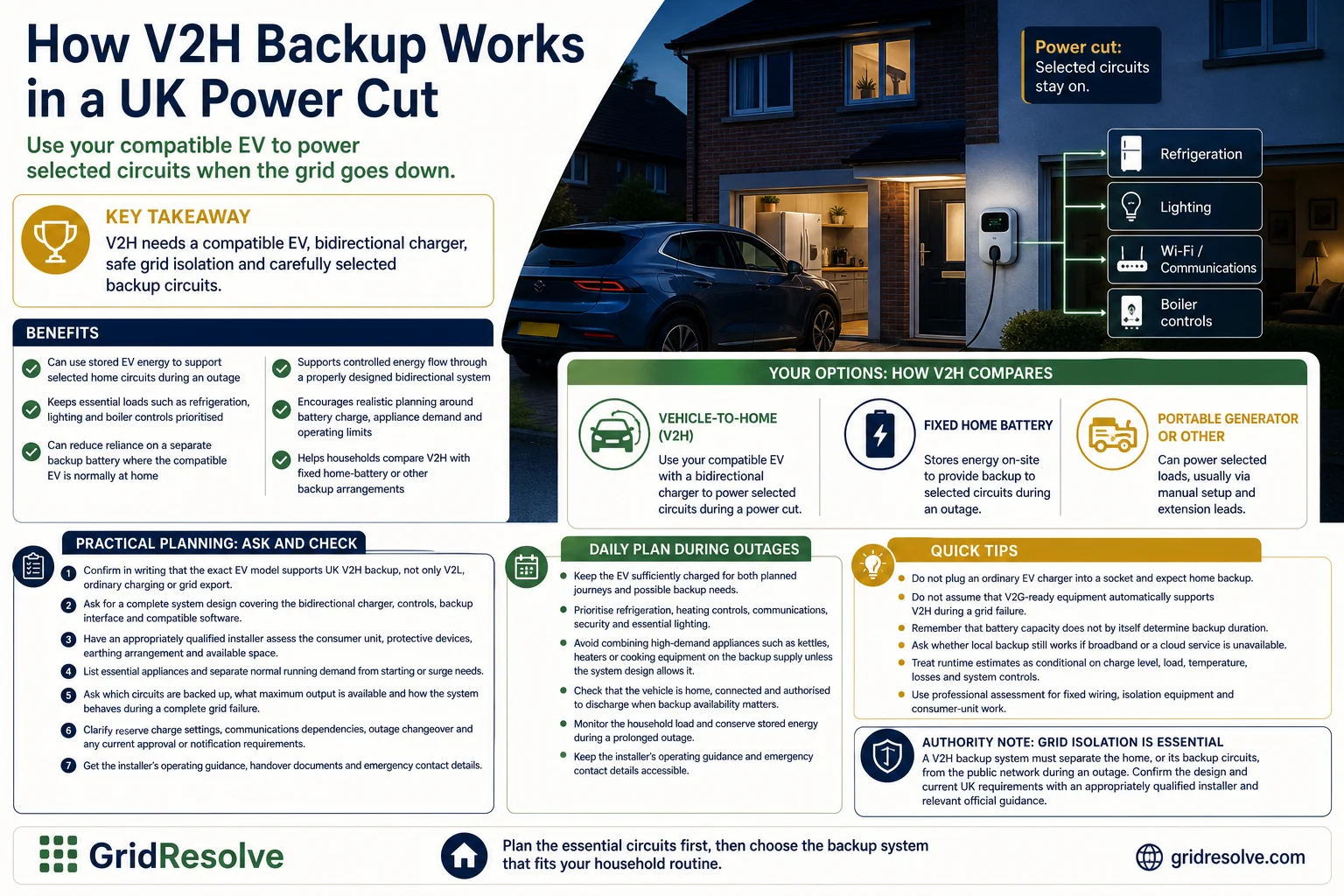
How V2H backup works during a UK power cut
Most EV charging is one-way: electricity flows from the grid, through the charger, into the car. A V2H system can reverse that flow. Energy stored in the vehicle battery passes through a bidirectional charger and associated control equipment to supply part of the property.
When the grid supply fails, the system detects the outage and isolates the home, or the relevant backup circuits, from the public network. It can then create a local supply for those circuits using the EV battery. The exact changeover method, control functions and operating limits depend on the equipment and its installation.
In a UK home, the system is designed around the property’s electrical arrangement and the normal domestic supply, rather than treating the car as a large portable battery. The bidirectional charger may be installed alongside a dedicated backup consumer unit or other equipment that separates selected loads from the rest of the house. A qualified installer needs to establish how the proposed system integrates with the existing consumer unit, earthing arrangement, meter position and incoming supply.
The car, charger and software must agree on the energy flow. Some products described as bidirectional may support scheduled charging or export functions without supporting home backup. Others may provide backup only with particular vehicles, firmware, accessories or installation arrangements. The product name alone is not enough.
If the terminology is unfamiliar, our guide to V2G, V2H and V2L in the UK explains how the different uses of an EV battery relate to one another. This article focuses specifically on supplying a home during a power cut.
Selected circuits are usually more practical than whole-home backup
A V2H system may be capable of supplying a substantial amount of power, but that does not mean every appliance should remain available during an outage. Whole-home backup has to cope with the combined demand of heating, cooking, hot water, washing appliances, pumps, lighting and miscellaneous loads. Some of those loads can also have high starting or short-term demand.
Selected-circuit backup takes a more controlled approach. An installer identifies the circuits that matter most and places them on the backup side of the system. Depending on the design, these might include:
- the fridge-freezer;
- boiler controls and a heating circulation pump;
- some lighting circuits;
- the broadband router and communications equipment;
- security equipment and door-entry systems; and
- ordinary sockets for chargers or low-power appliances.
This does not guarantee that every item on a circuit will be suitable. A socket circuit may also contain a kettle, fan heater or other high-demand appliance. The installer may need to separate loads further, apply controls or make clear which appliances should not be used together.
Whole-home backup is possible in some designs, but it can require more substantial equipment and careful load management. A home with an electric cooker, immersion heater, heat pump or electric vehicle charger has a different backup requirement from a property whose main loads are lights, refrigeration and gas-boiler controls. For a broader look at planning essential loads, see our guide to UK home backup power during a power cut.
What you need to check before relying on an EV for backup
1. The exact EV model and battery system
Battery capacity is only part of the question. The vehicle must support the relevant bidirectional function, and the manufacturer may restrict which chargers, software versions or operating modes can be used. Compatibility can vary between closely related vehicles and can change as manufacturers update their products.
Ask for written confirmation that the car supports V2H backup in the UK, not merely ordinary AC charging, V2L appliance output or a grid-export service. Check whether a particular state of charge must be maintained for driving, whether the vehicle can discharge while connected for long periods and whether use is limited by software or warranty conditions.
2. The bidirectional charger
An ordinary home charge point generally sends electricity to the EV only. V2H requires a charger that can safely receive energy from the vehicle and deliver it to the home in the intended operating mode. It also needs the controls required to respond to a grid outage and prevent unsafe energisation of the network.
Do not assume that a charge point advertised as “V2G-ready” will provide V2H backup. Ask which functions are supported, whether backup works during a complete grid failure, and what additional equipment is required. Some arrangements may need a separate backup interface, gateway, communications connection or energy-management system.
3. Your home’s electrical system
The proposed system has to suit the property’s supply, consumer unit, protective devices, earthing arrangement and available installation space. The installer should also consider the loads you want to back up and the starting demand of motors and compressors such as those in refrigeration equipment or pumps.
Fixed wiring, isolation equipment and consumer-unit work are not suitable DIY projects. Ask an appropriately qualified UK installer to assess the installation and explain which circuits will remain live, how the changeover operates and what happens if the car is unplugged or unavailable.
4. The smart meter and electricity arrangements
A smart meter may be relevant to monitoring, tariff management or export arrangements, but it does not turn an ordinary EV charger into a V2H system. Nor does a tariff that supports cheaper charging automatically support backup operation.
Check the relationship between the charger, energy supplier, software platform and any export arrangement. V2H backup can be configured differently from exporting energy to the grid, and a system may continue to provide local backup even when grid export is not part of the service. The installer and supplier should explain which functions depend on an internet connection, account, tariff or external service.
5. The outage behaviour
Ask practical questions before you buy. How quickly does backup become available? Are there brief interruptions? Can the system start without the grid? Does it supply all phases or only the circuits connected to the backup output? Can the car begin discharging if it was already plugged in, and what happens if it is connected after the outage begins?
These details affect sensitive electronics, heating controls and any appliance that does not respond well to an interruption. They also determine whether the system is genuinely useful for your household rather than merely technically capable of sending energy somewhere.
Battery state of charge and backup duration
An EV battery stores energy, measured in kilowatt-hours (kWh). The home’s appliances use power, measured in watts or kilowatts. A system’s duration depends on the relationship between those two figures, not on battery capacity alone.
A partly charged car may have less energy available than expected. The system may also reserve charge for driving, stop at a manufacturer-defined limit or reduce its output under particular conditions. Conversion losses, the charger’s efficiency and the changing duty cycle of appliances reduce the energy delivered to the home.
Loads vary throughout the outage. A fridge-freezer cycles rather than drawing its maximum continuously. A boiler pump may run intermittently, while lighting and networking equipment can remain on for hours. A kettle or electric heater can use a great deal of power in a short period. Starting demand from compressors and motors also needs to be considered separately from normal running power.
Before installation, list the appliances you expect to use and check their data plates or manufacturer specifications. Separate running power from starting or surge requirements. Then ask the installer to model a realistic combination of loads and explain the expected operating limits. Treat any runtime estimate as conditional on battery state of charge, load, temperature, conversion losses and the system’s controls.
When V2H will not keep the house running
The most obvious limitation is availability. The car may be away from home, unplugged, below its reserve level or needed for an urgent journey. A V2H system cannot draw energy from a vehicle that is not connected and authorised to discharge.
Compatibility is another barrier. The EV may support only one-way charging or a different form of vehicle energy output. The charger may be bidirectional but not approved or configured for outage backup. The home may need electrical work that is impractical, or the software and communications service may not support the required mode.
Some systems may also stop operating during an outage if they depend on external communications, a particular control platform or a condition that is not available when the grid is down. Clarify whether local backup remains possible without broadband or a cloud service.
Finally, an outage can outlast the energy available in the vehicle. V2H is not an unlimited supply. If the car reaches its reserve or operating limit, the backed-up circuits will lose power unless another source is available. That may be acceptable for short interruptions, but it should be part of the plan rather than an unwelcome surprise.
Questions to put to an installer
A useful quotation should describe a complete backup system, not just a bidirectional charger. Ask the installer to identify the compatible vehicle models, the backed-up circuits, maximum continuous and short-term output, changeover behaviour, communications dependencies and any reserve charge settings.
Request a written explanation of what the system does during a power cut and what it does not do. Check who is responsible for confirming vehicle and charger compatibility, whether the installation needs approval or notification under current UK requirements, and what inspections or documentation will be provided. These details can depend on the equipment and the property, so verify them with the installer and the relevant current official guidance before work begins.
Also consider the household routine. If the car is normally driven during working hours, a fixed home battery or another backup arrangement may be more dependable for your priorities. If the EV is usually parked at home and the compatible equipment is already available, V2H could make better use of energy storage you already own.
Frequently Asked Questions
Can any electric car provide V2H backup?
No. The vehicle must support the required bidirectional function, and it must be compatible with the charger and control system used at the property. V2L capability or a large battery does not by itself prove that the car can supply a home during a power cut. Check the exact model, software and market configuration with the vehicle manufacturer and installer.
Will V2H power every appliance in my house?
Not necessarily. Many installations are designed around selected essential circuits so that demand stays within the charger and vehicle’s limits. Whole-home backup may be possible in some properties, but high-power appliances, motors, compressors and electric heating need particular attention. Ask for a load assessment rather than assuming that the normal grid supply can be replicated.
Does a smart meter make V2H possible?
No. A smart meter can form part of the home’s monitoring or electricity arrangements, but it is not a bidirectional charger or an outage-isolation device. V2H depends on the vehicle, charger, home electrical system and control equipment working together. A supplier or installer should confirm which smart-meter, tariff or software functions are actually required.
Can the EV keep my home powered for several days?
That depends on the usable energy available, the battery’s starting state of charge, the loads, conversion losses, weather and the system’s operating limits. Refrigeration, heating controls and lighting may use relatively little energy compared with electric cooking or heating, but the total can vary considerably. Have the installer calculate scenarios based on your actual appliances and remember that the car may need to retain charge for transport.
Your next step is to write down the circuits and appliances you would want during an outage, then ask a qualified UK installer and the vehicle manufacturer to confirm whether your exact EV, charger and home can support V2H backup. That check is more valuable than choosing equipment based on the battery size or a bidirectional label alone.