
The power goes off while dinner is cooking. The fridge-freezer is still full, the broadband router has stopped, and the boiler controls have gone dark. Outside, your electric car is parked on the drive with charge in its battery. Could it run a few essential appliances until the electricity returns?
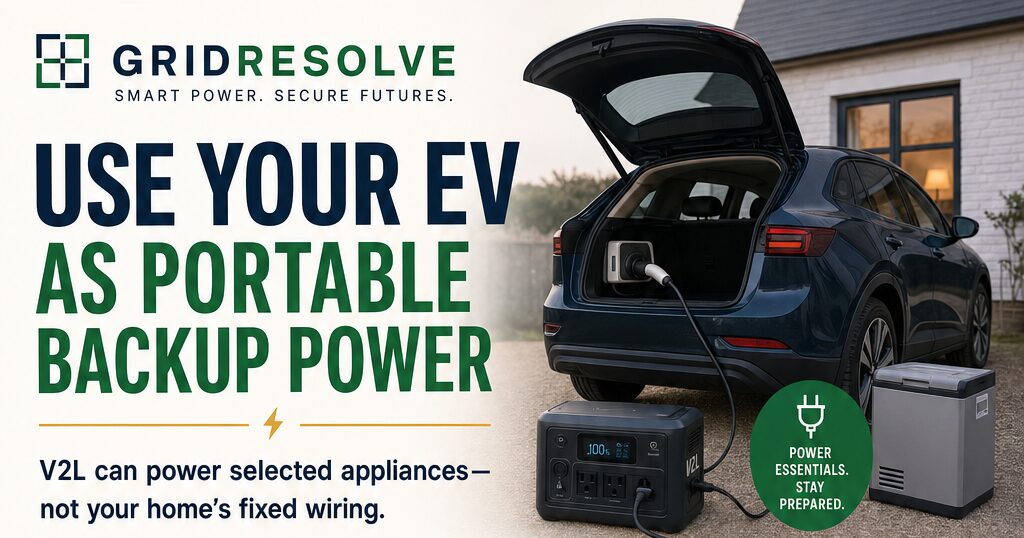
If the car supports vehicle-to-load (V2L), possibly. V2L can turn a compatible EV into a portable 230V power source for selected appliances, chargers and other suitable equipment. It is not the same as powering your house through its wiring, however. The safest approach is to treat the car as an outdoor source for individual loads, not as an improvised replacement for the mains supply.
What V2L means
Vehicle-to-load describes electricity flowing from an EV battery to a separate electrical load. The car normally uses its battery to drive the traction motor, but V2L allows an approved inverter and outlet arrangement to provide alternating-current power for equipment outside the vehicle.
Depending on the model, the outlet may be built into the car or available through a manufacturer-approved adapter connected to the charging inlet. In the UK, the output is intended for compatible 230V, 50Hz appliances. The vehicle’s handbook and the V2L equipment specification should define the permitted load, connector, environmental conditions and operating procedure.
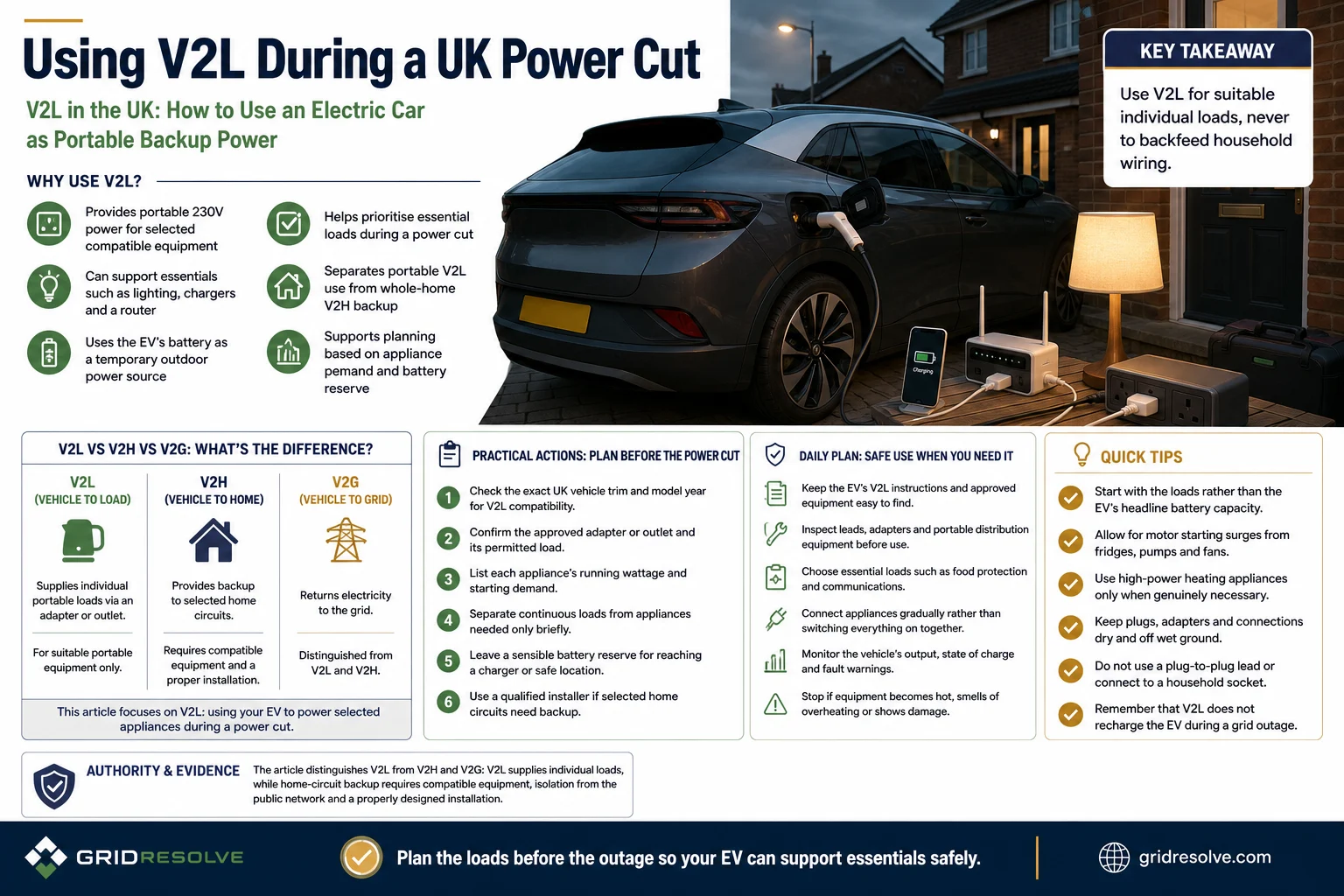
V2L is one part of the wider X2G family. GridResolve’s guide to V2G, V2H and V2L in the UK explains the distinctions, but the short version is:
- V2L: the vehicle supplies individual loads or portable equipment.
- V2H: the vehicle supplies a home or selected home circuits through a designed, installed system.
- V2G: the vehicle exchanges energy with the public electricity grid under a suitable arrangement.
A car that supports V2L does not automatically support V2H or V2G. Those functions need different vehicle, charger, control and installation capabilities.
Which UK EVs may support V2L?
V2L is available on some EVs sold in the UK, but it is not a consequence of having a large battery. Compatibility depends on the vehicle platform, model year, trim, market and software configuration.
Examples of EV ranges that have offered V2L capability in some UK versions include the Hyundai Ioniq 5 and Ioniq 6, Kia EV6, Genesis GV60, and selected models from manufacturers such as MG and BYD. This is not a complete list, and availability can differ between versions or change with a model update. A similarly named car in another market may have different equipment.
Check the exact vehicle identification, not just the model family. Look in the owner’s manual, technical specification and the manufacturer’s UK support material for:
- whether V2L is enabled on that specific trim and model year;
- whether power is available from an interior socket, an exterior socket, a charging-port adapter, or more than one route;
- the maximum continuous output and any short-duration or temperature-related limits;
- the permitted connector or adapter; and
- the minimum state of charge or other conditions that stop the function.
Do not assume that a generic Type 2 accessory will work simply because the car has a Type 2 charging inlet. V2L adapters contain the relevant electrical and signalling arrangements, and the vehicle may only recognise approved equipment. Use the manufacturer’s accessory or one that the vehicle documentation explicitly supports.
What equipment do you need?
The simplest arrangement is a compatible EV, its approved V2L adapter or outlet, and one suitable appliance. For example, you might power a lamp, charge phones and laptops, or run a router from a properly rated connection.
If you need to supply several low-power items, a suitable extension lead or distribution unit may be useful. It must be in good condition, rated for the intended load and appropriate for the environment. Outdoor use requires equipment with suitable weather protection; ordinary indoor extension equipment should not be left exposed to rain or standing water. Keep plugs, sockets and adapters off wet ground and follow the vehicle and accessory instructions.
Do not use a V2L lead to connect the car to a household wall socket, a ring final circuit or a consumer unit. A plug-to-plug lead is particularly dangerous. It can energise wiring unexpectedly, defeat the intended protection arrangements and send electricity towards a supply that may be assumed to be isolated. A V2L outlet is for suitable loads connected at the outlet—not for feeding the property’s fixed wiring.
If you want an EV to support selected circuits in the house, that is a V2H project. It requires compatible equipment, isolation from the public network and a properly designed installation. See the separate guide to V2H backup in the UK rather than improvising a connection during an outage.
How to use V2L during a power cut
Start with the loads, not the car’s battery size. Make a short list of what you actually need: perhaps a fridge-freezer, a few lamps, a router, phone chargers or a laptop. Separate items that need to run continuously from those you can use briefly.
Read the data plate or manufacturer specification for each appliance. Look for its running power in watts and, where relevant, its starting or surge demand. The car’s V2L limit is a power limit, measured in watts or kilowatts. The energy stored in the battery is measured in kilowatt-hours. These are related but different questions:
- Power: can the V2L output handle the equipment at this moment?
- Energy: how long can the battery provide that load before reaching the vehicle’s permitted reserve?
Connect the approved V2L equipment as the manufacturer describes, then add loads carefully rather than switching everything on at once. Keep an eye on the vehicle’s displayed output and state of charge. If the system reports an overload, fault or excessive temperature, disconnect loads and follow the handbook.
A fridge or freezer can be a more demanding load than its average running figure suggests because its compressor may draw a brief starting surge. Pumps, power tools, fans and other motor-driven equipment can behave similarly. A kettle, fan heater, microwave or portable electric heater may have a high running demand even if it has no motor. Several modest appliances can also exceed the V2L limit when used together.
Where possible, let a refrigerator or freezer cycle rather than trying to run every high-power appliance at the same time. You might charge devices in batches and use a kettle briefly instead of adding a large continuous heating load. These are load-management choices, not guarantees: check the individual appliance figures and the vehicle’s limits.
Realistic battery and runtime limits
An EV battery can hold considerably more energy than many small portable batteries, but V2L is not a free or unlimited supply. The car’s usable energy is lower than its headline battery capacity, and the conversion from battery power to AC output has losses. The vehicle may also reserve charge for driving, impose a minimum state of charge, or stop V2L in conditions outside its operating range.
Runtime depends on the actual load, inverter efficiency, appliance duty cycle, starting demand, temperature, battery condition and the manufacturer’s restrictions. A fridge compressor does not run continuously, so its average energy use may differ greatly from its starting demand. Conversely, a heater or kettle converts electricity into heat at a substantial rate while it is switched on.
Think in terms of a load plan rather than a promised number of hours. Record each appliance’s wattage, estimate how often it runs, and leave a sensible reserve for getting the car to a charger or another safe location. The vehicle’s displayed estimate is more useful for your particular conditions than a generic runtime calculation.
V2L also does not make the EV charge itself during an outage. If the grid is down, the car’s available energy is finite unless you have another permitted charging source. If the outage may last, prioritise the equipment that protects food, communication or basic household operation, and avoid treating the car as a whole-home supply.
UK safety boundaries to keep clear
V2L output may look like an ordinary socket, but the consequences of using it incorrectly are not ordinary. Keep these boundaries in place:
- Never backfeed a house through a wall socket, cooker outlet, outdoor socket or any other fixed-wiring connection.
- Never connect V2L to the consumer unit or attempt to create a changeover arrangement yourself.
- Do not use damaged leads, overloaded extension equipment or accessories that are not approved for the vehicle.
- Keep the car, adapter and connections positioned as the handbook requires, protected from water and away from trip hazards where practical.
- Do not daisy-chain extension leads or run cables where doors, vehicles or foot traffic can damage them.
- Stop using the arrangement if a plug, cable, adapter or outlet becomes unusually hot, smells of overheating, or shows signs of damage.
Even if the grid appears to be off at your property, the fixed wiring may not be safely isolated for an improvised supply. Electricity may also return without warning. Supplying household circuits during an outage needs equipment designed for that purpose and work by an appropriately qualified professional. The wider UK home backup power guide covers the planning questions without assuming that every home needs an installed system.
V2L is also not a substitute for a planned continuity arrangement for life-critical or medically important equipment. Follow the device manufacturer’s instructions and seek advice from the relevant clinical and electrical professionals before relying on any backup source.
Frequently Asked Questions
Can any electric car provide V2L?
No. V2L requires vehicle hardware, software and an outlet or approved adapter designed for bidirectional discharge. Check the exact UK model, trim and model year in the manufacturer’s documentation.
Can V2L power my whole house?
Not by plugging the car into a household socket. V2L is intended for individual loads or suitable portable distribution equipment. Powering selected home circuits is a separate V2H installation that must isolate the property from the public network.
Can I run a fridge-freezer from V2L?
Possibly, if the vehicle’s output can handle the fridge-freezer’s running and starting demands and the connection is suitable. Check the appliance specification and watch for overload or fault warnings, especially when other appliances are connected.
Will V2L drain the battery quickly?
It depends on the load and how often appliances cycle. High-power heating appliances use energy quickly, while intermittent loads such as a fridge may have a lower average demand but a higher starting surge. Allow for conversion losses and any vehicle reserve or cut-off settings.
Make a simple V2L plan before the next outage
Find the V2L instructions for your exact EV, identify the approved adapter or outlet, and write down the wattage and starting requirements of the appliances you would actually use. Store suitable leads where they remain dry and inspect them before an emergency. If your aim is to keep house circuits live rather than run appliances beside the car, stop at the planning stage and speak to a suitably qualified installer about a proper V2H design.