

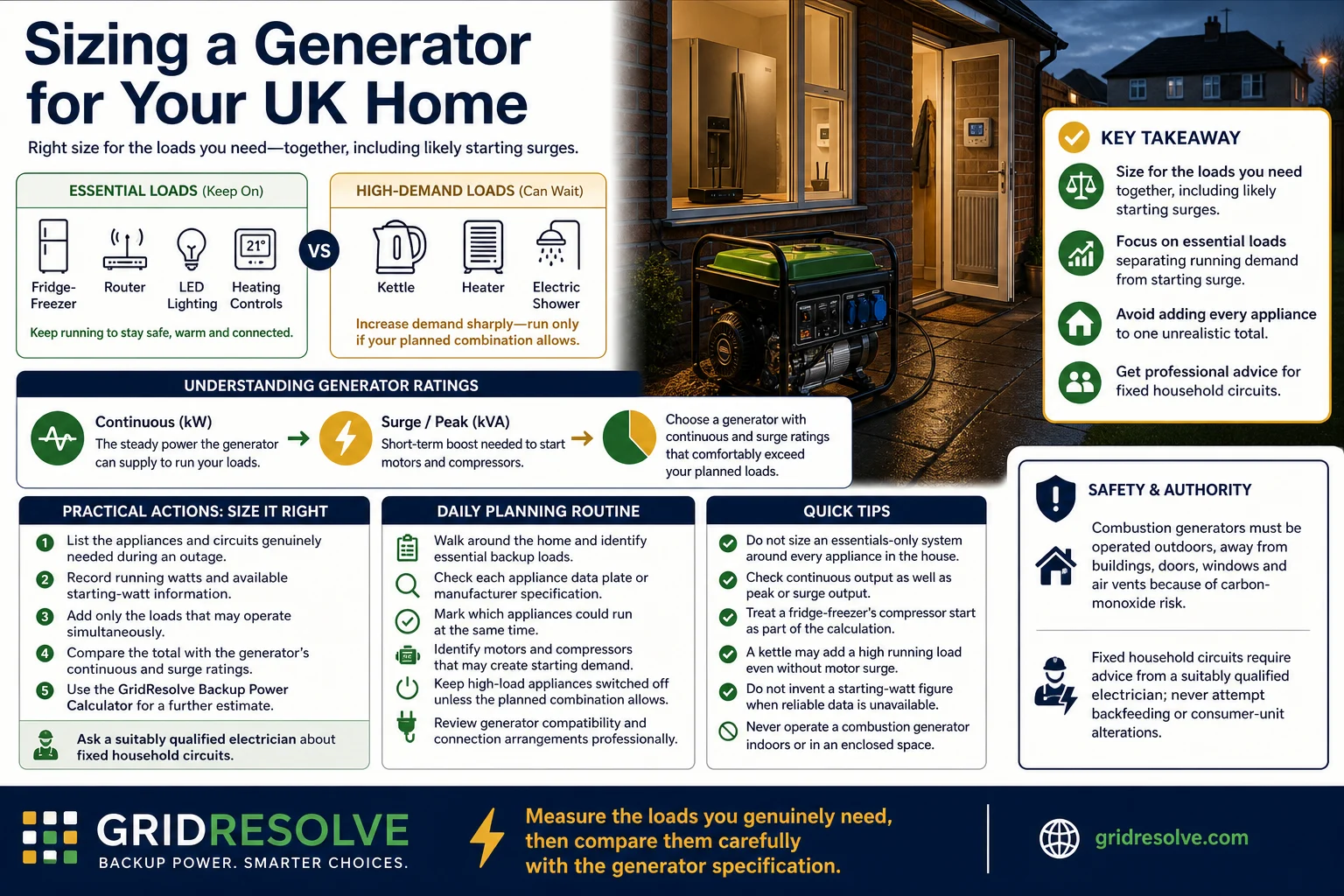
A power cut starts on a cold evening. The fridge-freezer needs to keep running, the router is useful, a few lights matter and perhaps the central-heating controls need power. The electric shower, immersion heater, oven and tumble dryer can wait. That is a very different requirement from powering every appliance in the house.
If you are asking, what size generator do I need to run a house in the UK?, start by sizing the loads you genuinely want during an outage. A generator chosen for the home’s theoretical maximum demand will usually be much larger than one chosen for a sensible group of essentials. The calculation has two parts: the power needed at one time, and the short starting surge required by motors and compressors.
Decide what the generator must run
Make two lists before looking at generator ratings. The first contains essential loads: equipment that should remain available during a power cut. The second contains non-essential or deferrable loads that you can leave off, use one at a time or run only when the generator has spare capacity.
Typical essential loads in a UK home might include:
- a fridge-freezer;
- a few LED lights;
- the broadband router and an occasional phone charger;
- heating controls, if their electrical demand and connection arrangement are suitable;
- a television, computer or other modest convenience load.
Loads commonly left out of an essentials-only calculation include electric showers, immersion heaters, storage heaters, kettles, ovens, hobs, tumble dryers, washing machines during their heating cycle and portable electric heaters. Some of these appliances can draw more power individually than several lights and electronic devices combined.
Do not treat this as a recommendation to connect equipment yourself. A combustion generator must be outdoors, well away from buildings, doors, windows and air vents; it must not be operated in a house, garage, basement or other enclosed or partly enclosed space because of carbon-monoxide risk. If the generator is to supply fixed household circuits, discuss the arrangement with a suitably qualified electrician rather than attempting backfeeding or alterations to a consumer unit.
Record running watts and starting watts separately
Running watts describe the power an appliance draws while operating normally. Starting watts, sometimes called starting or surge demand, describe the brief higher demand that can occur when a motor or compressor starts. A generator needs enough continuous output for the running load and enough surge capacity for the starting event.
Motors in fridge-freezers, freezers, pumps and some tools may have a starting demand above their running figure. The size and duration of that surge vary by appliance, motor design, temperature and generator behaviour. Electronics with switched-mode power supplies can also behave differently from simple resistive loads.
Use the appliance data plate and manufacturer specification as your first source. A plug-in energy meter can help with appliances that use a standard plug, although not every meter captures a very brief starting surge accurately. The existing guide to measuring a refrigerator’s power use explains why a compressor’s running figure is not the whole requirement.
Write down three columns for each load:
- normal running watts;
- starting watts or the manufacturer’s stated surge requirement, if available;
- whether the appliance will operate continuously, intermittently or only on demand.
If no reliable starting figure is available, do not invent one. Ask the appliance manufacturer or choose a generator whose published surge capability leaves a sensible margin after checking the actual loads.
Add only the loads that may run together
The key calculation is not the sum of every appliance in the house. It is the sum of the loads that could be operating at the same time.
For an essentials-only plan, you might add the fridge-freezer’s running demand, lights that are likely to be on, the router, heating controls and a television. You then check whether a compressor starting at that moment can be supported by the generator’s surge rating. A kettle or microwave may be included as an occasional load, but only if you account for its relatively high running demand and agree that other discretionary loads will be switched off while it runs.
A practical worksheet looks like this:
| Load | Running demand | Starting or surge check | Runs at the same time? |
|---|---|---|---|
| Fridge-freezer | Use data plate or measurement | Check compressor requirement | Usually possible |
| LED lighting | Add only the lights needed | Usually a small concern, but verify | Likely |
| Router | Check its power adaptor | Usually low, model-dependent | Likely |
| Kettle or microwave | Use the rating plate | Usually no motor surge, but high running load | Run selectively |
Allowing a margin is sensible because nameplate figures, measurements and real operating conditions are not perfectly identical. The margin should be based on the manufacturer’s guidance and your uncertainty, not a universal percentage presented as a guarantee.
Worked example: essentials-only backup
Suppose a household has measured or checked the following illustrative running loads:
- fridge-freezer: 180W while the compressor is running;
- selected LED lights: 60W;
- router: 15W;
- heating controls and circulation equipment: 100W;
- television: 100W.
The simultaneous running total is 455W. That is not automatically a 455W generator specification, because the fridge-freezer may need a short starting surge and the heating equipment may have its own motor. The buyer should check the generator’s continuous output and surge output against those requirements, then add a reasonable allowance for uncertainty. A unit in the broad low-kilowatt class might be appropriate for this kind of essentials-only load, but the appliance specifications decide the result; the example is not a universal recommendation.
If the television is removed, the running total falls. If a kettle is added, the total can rise sharply for the few minutes it is switched on. This shows why a household may need a different generator size for basic continuity than for cooking or electric space heating.
Worked example: broader household coverage
Now imagine adding a 2,000W kettle, a 2,000W microwave and a 2,500W portable heater to the previous 455W essentials. If all three were switched on together, the simple running total would be 6,955W. That is already far above the essentials-only requirement, before checking any starting demand or other appliances.
But simultaneous use is a choice, not necessarily the design target. A household might decide to run the kettle briefly with the heater off, or to use the microwave after the kettle has finished. That reduces the required simultaneous output, although it still requires clear operating discipline and a generator that can tolerate the selected combination.
Electric showers, immersion heaters and ovens deserve particular caution in the calculation because their heating elements can create a large continuous load. If you want those appliances available during an outage, do not assume that a small domestic generator will cope. Use their actual ratings and obtain professional advice about the intended supply arrangement.
How generator kW and kVA ratings relate to house demand
Generator output may be stated in watts, kilowatts (kW), volt-amperes (VA) or kilovolt-amperes (kVA). One kilowatt is 1,000 watts. Kilowatts describe real power used by the load, while kVA describes apparent power, which also reflects the effect of power factor.
For a simple resistive load, such as a basic heating element, kW and kVA can be close. Motors, transformers and some electronic equipment can have a lower power factor, so the relationship is not one-to-one. A simplified relationship is:
kW = kVA × power factor
Use the generator manufacturer’s stated continuous kW rating and kVA rating together, rather than converting one with an assumed power factor. Also check the surge rating separately. A generator labelled with a large kVA figure may still be a poor match if its continuous output or motor-starting capability is insufficient.
UK household equipment is generally designed around a 230V, 50Hz supply, so frequency and voltage compatibility matter as well as the headline output. Check the generator specification and the requirements of sensitive equipment before making a decision.
What size generator do I need to run a house in the UK?
There is no single answer because “a house” can mean a fridge, router and lights, or nearly every high-power appliance operating together. A useful sizing process is:
- List the circuits or appliances you actually need.
- Find their running wattage from the data plate, a measurement or the manufacturer.
- Add only the loads that may operate simultaneously.
- Identify motor and compressor starting requirements.
- Compare both the total running load and the worst likely starting combination with the generator’s continuous and surge ratings.
- Review the result with an electrician if fixed household circuits are involved.
Once you have chosen the appliances and circuits, put the figures into the GridResolve Backup Power Calculator as the next practical check. It helps turn your list into a more consistent estimate; it cannot replace the generator’s own specification or professional advice for a fixed installation.
Remember that generator sizing is about power, measured in W or kW. How long it can keep those loads operating is a separate energy and fuel question. Running time varies with load, duty cycle, environmental conditions, fuel and the manufacturer’s operating limits. For the distinction between instantaneous demand and energy over time, see watts versus watt-hours.
Frequently Asked Questions
Is a 3kW generator enough for a UK house?
It may be enough for selected essentials, depending on their measured running demand and starting requirements. It is unlikely to cover unrestricted use of electric showers, immersion heaters, ovens, heaters and other high-load appliances at the same time. Compare the actual simultaneous load with both the continuous and surge ratings.
Should I add the starting watts of every appliance?
No. Starting demand is a brief event, so adding every appliance’s surge figure can produce an unrealistic result. Identify which motors or compressors could start at the same time as the other loads, then check that likely combination against the generator’s surge capability. Follow the manufacturer’s method where it provides one.
Can I run a fridge-freezer and kettle from the same generator?
Possibly, but the kettle’s high running demand and the fridge-freezer’s compressor start must both fit within the generator’s ratings. If the kettle is switched on while the compressor starts, the combined demand may be higher than expected. Measure or verify both loads and avoid assuming that a generator’s peak figure is its continuous capacity.
Your next step is to walk around the house and record the data-plate wattage for every appliance you would genuinely want during a cut. Mark which ones can run together, check the largest starting demand and then use the calculator before comparing generator specifications.