

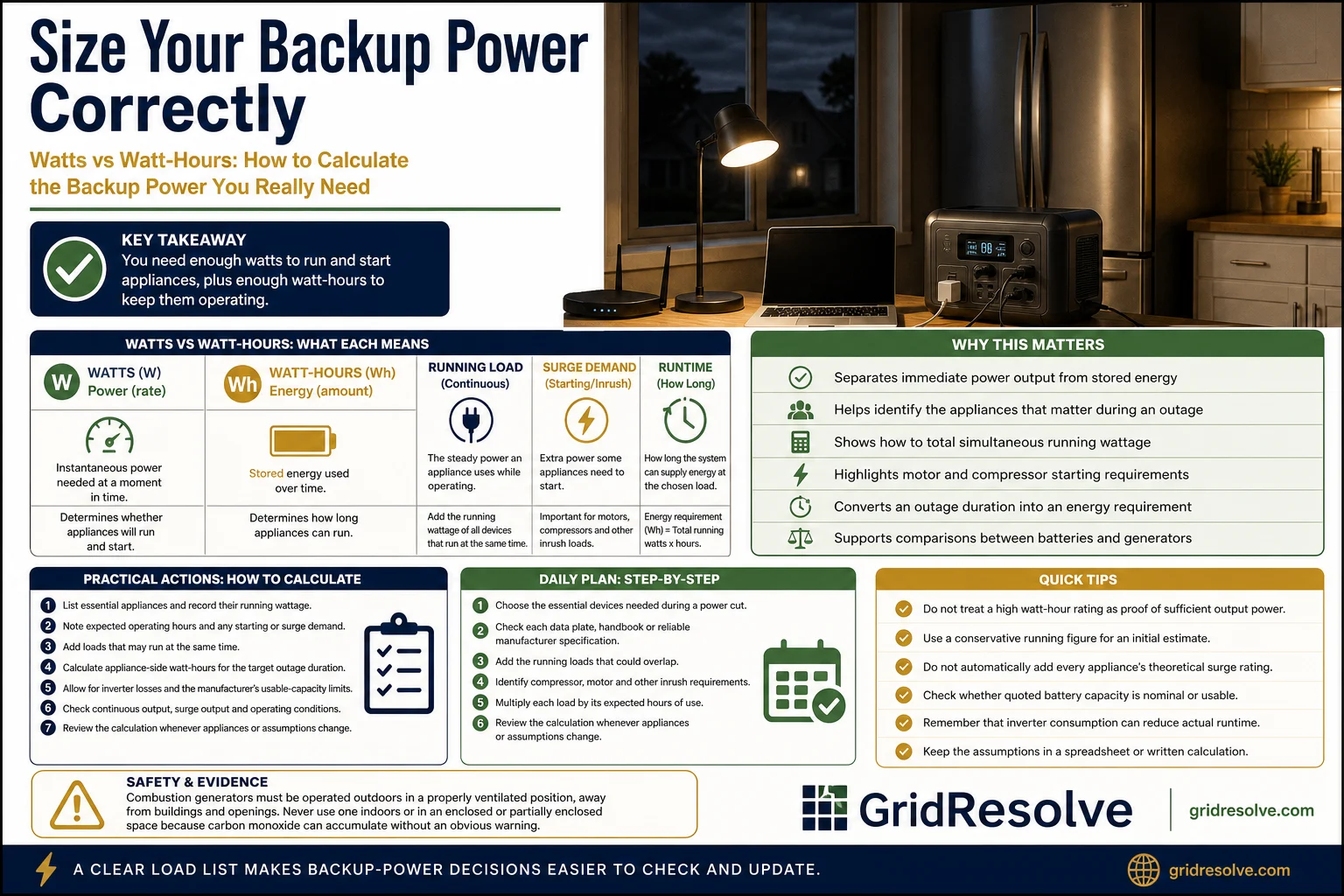
The power goes off during an evening outage. A portable battery shows enough stored energy to run your essential equipment for several hours, but its output rating is too low for the fridge compressor to start. The display may promise plenty of watt-hours, yet the appliance still will not run.
That apparent contradiction comes from confusing two different measurements. Watts describe the rate at which equipment uses or supplies power. Watt-hours describe how much energy is stored or consumed over time. You need both figures when planning backup power.
This calculation-led approach works for a portable power station, a fuel generator or a home battery. The equipment differs, but the questions are the same: how much power must it deliver at once, and how much energy must it provide before the outage ends?
Watts, kilowatts, watt-hours and kilowatt-hours
A watt (W) is a unit of power. It tells you the appliance’s electrical demand at a particular moment. A 100 W lamp uses power at a rate of 100 watts while it is switched on.
A kilowatt (kW) is 1,000 watts. Backup equipment may quote a continuous output in watts or kilowatts, then give a separate short-term surge or starting-output figure.
A watt-hour (Wh) is a unit of energy. It represents 1 watt used for 1 hour. A 100 W appliance running continuously for 5 hours would consume:
100 W × 5 hours = 500 Wh
A kilowatt-hour (kWh) is 1,000 Wh. Therefore, 500 Wh is 0.5 kWh. Battery capacities are often advertised in Wh or kWh, while household electricity use is commonly discussed in kWh.
Power answers, “Can the system run these loads right now?” Energy answers, “Can it keep them running for the required duration?” A system can pass one test and fail the other.
Start with the loads you actually need
Do not begin with the capacity of a battery or the headline output of a generator. Make a list of the appliances and devices you want to use during an outage, then find their electrical information from the data plate, handbook or manufacturer specification.
Record three things where available:
- the normal or running wattage;
- the expected hours of use during the outage; and
- the starting or surge requirement, especially for motors, compressors and some power tools.
Some appliances have a variable or intermittent demand. A fridge compressor cycles rather than running continuously. A boiler pump may operate only when heating is active, and a laptop charger may draw less than its maximum label rating. For a first calculation, use a conservative running figure. For a more realistic energy estimate, use the expected duty cycle, provided you understand that actual behaviour will vary.
Total the running wattage
If several loads may operate at the same time, add their running wattages:
Total running power = load 1 + load 2 + load 3 + …
For an illustrative essential-load plan, assume the following figures have been taken from the relevant specifications:
- router: 12 W;
- LED lighting: 40 W;
- laptop charger: 60 W; and
- fridge-freezer while its compressor is running: 80 W.
The simultaneous running total is:
12 + 40 + 60 + 80 = 192 W
This is not a universal household figure. Your appliances may use substantially more or less, and the fridge-freezer’s average consumption may be lower than its compressor-running figure because the compressor cycles.
Allow for starting and surge power
Motors and compressors can briefly draw more power when they start than they use once running. Refrigeration equipment, pumps, fans and some tools are common examples. Electronic equipment can also have short inrush demands.
The backup source must be able to tolerate the starting event as well as the normal load. Check the appliance specification and the power source’s continuous and surge ratings. A vague “peak” number is not enough unless you know how long it can be sustained and how the manufacturer defines it.
Using the illustrative plan above, suppose the fridge-freezer has a stated 600 W starting demand. If all the other devices remain on, a simple worst-case simultaneous peak would be:
600 W starting fridge load + 12 W + 40 W + 60 W = 712 W
This is a planning example, not a claim about typical refrigeration equipment. The actual starting demand may be different, and the other loads may not coincide with the compressor start. It is sensible to consider the possibility of overlap rather than assuming that only one device will ever start at a time.
Do not add every appliance’s maximum surge automatically and treat that result as a guaranteed requirement. Some starts will not overlap, while some power sources handle short peaks differently. Use the manufacturer’s figures and allow a sensible margin rather than relying on a borderline match.
Convert a runtime target into watt-hours
Once you have an estimated running load, multiply it by the number of hours you want the system to operate:
Energy used = running power × runtime
With the illustrative 192 W load and an eight-hour target:
192 W × 8 hours = 1,536 Wh
That is the energy delivered to the appliances. A battery system will need more stored energy because the inverter and other conversion electronics consume some power. The battery may also reserve part of its nominal capacity to protect the cells or meet operating limits.
A practical planning formula is:
Required nominal battery energy = appliance energy ÷ inverter efficiency ÷ usable-capacity fraction
For an illustrative calculation, assume 85% overall inverter efficiency and that 80% of the quoted battery capacity is available for the intended use:
1,536 Wh ÷ 0.85 ÷ 0.80 = about 2,259 Wh
That result should not be read as a universal correction factor. Efficiency varies with load, temperature, battery state and equipment design. The usable fraction may be stated by the manufacturer, or the quoted capacity may already be presented as usable energy. Check the specification carefully so you do not apply the same loss twice.
Account for duty cycle and changing loads
If a device does not run continuously, its average energy use can be lower than its running wattage multiplied by the full outage duration. For example, a compressor that runs for only part of an hour will not consume its full running wattage for every minute.
That does not remove the need to size the inverter for its starting and running power. It only changes the energy calculation. In practice, temperature, door openings, thermostat settings, battery condition and the selected loads can all change the result.
For mixed loads, calculate each item separately when their schedules differ:
Total energy = (load 1 W × hours) + (load 2 W × hours) + …
Then apply conversion losses and the manufacturer’s usable-capacity limit. If you want resilience for an uncertain outage, include additional operating time rather than assuming the first estimate will be exact.
How the calculation applies to different backup sources
Portable power stations
A portable power station normally publishes an energy capacity in Wh and an AC output in W. Compare the capacity with your adjusted Wh requirement, and compare the continuous output with your total running load. Then check whether its surge rating is suitable for the largest starting demand.
Its AC inverter may consume energy even when the connected appliances are drawing little power. Low loads can therefore produce a different runtime from a simple capacity division. Read the stated usable capacity, efficiency or runtime conditions rather than treating the printed battery capacity as energy available at the sockets.
If you need to power equipment outside the home’s fixed wiring, keep the plan limited to suitable individual loads and follow the product instructions. The separate question of keeping selected household circuits running needs a properly designed installation; the guide to essential appliances during a power cut covers that wider planning issue.
Fuel generators
For a generator, the key power comparison is its rated continuous output against the running load, plus its short-term starting capability. A generator’s fuel runtime is not the same as a battery’s Wh capacity. Fuel consumption changes with electrical load, operating conditions, fuel and the generator’s design.
A generator may also have less available output in certain environmental conditions. Check the manufacturer’s derating information and treat the published runtime as conditional on its stated test load and conditions.
Combustion generators must be operated outdoors in a properly ventilated position, well away from buildings and openings. Never run one indoors, in a garage, basement, shed or another enclosed or partially enclosed space: carbon monoxide can accumulate without an obvious warning. Fixed connections to a building should be assessed and installed by an appropriately qualified professional rather than improvised.
Home batteries
A home battery has the same two constraints, even when its capacity is quoted in kWh. Its usable energy determines how long it can support the chosen loads; its inverter output determines which loads can run together and whether motor starts are tolerated.
Read whether the published capacity is nominal or usable, and check any minimum state-of-charge reserve, discharge limits and power-duration conditions. Actual runtime depends on the load profile, inverter losses, battery temperature, state of charge and system controls.
An EV may also be part of a portable or installed backup arrangement, but a large vehicle battery does not by itself establish the available socket output or home-backup capability. For an overview of using a compatible vehicle for individual appliances, see how V2L can provide portable backup power.
A quick calculation checklist
- List only the appliances and devices that matter during the outage.
- Record each running wattage from a data plate or reliable specification.
- Add loads that may operate at the same time.
- Identify starting or surge requirements for motors, compressors and other inrush loads.
- Multiply each running load by its expected operating hours.
- Add the energy figures to obtain the appliance-side Wh requirement.
- Allow for inverter losses, usable battery capacity and any manufacturer reserve.
- Check the source’s continuous output, surge output and operating limits against the plan.
Keep the assumptions with your calculation. If you later add a freezer, pump or cooking appliance, update both the running-watt total and the energy total. A small spreadsheet is often more useful than a single headline number because it shows which assumption is driving the result.
Frequently Asked Questions
Is a higher watt-hour rating always better for backup power?
No. More watt-hours can provide more stored energy, but they do not necessarily increase the output power available at one moment. The system still needs enough continuous output for the running loads and enough surge capability for starting equipment.
Should I add the surge rating of every appliance?
Not automatically. Identify which devices may start at the same time and use their specified starting demands as part of a realistic worst-case calculation. Adding every theoretical peak can overstate the requirement, while ignoring compressor or motor starts can leave the system unable to start a load.
Why is my measured runtime shorter than the watt-hour calculation?
The simple calculation may omit inverter consumption, conversion losses, battery reserve, temperature effects, changing load and the difference between nominal and usable capacity. Check the source’s stated test conditions and measure the actual load profile if you need a more dependable estimate.
Your next practical step is to photograph the data plates or specifications for the appliances you want to keep running, enter their running watts and hours into a simple table, and then check the largest starting demand separately. That gives you a defensible power-and-energy target before you compare backup systems.