

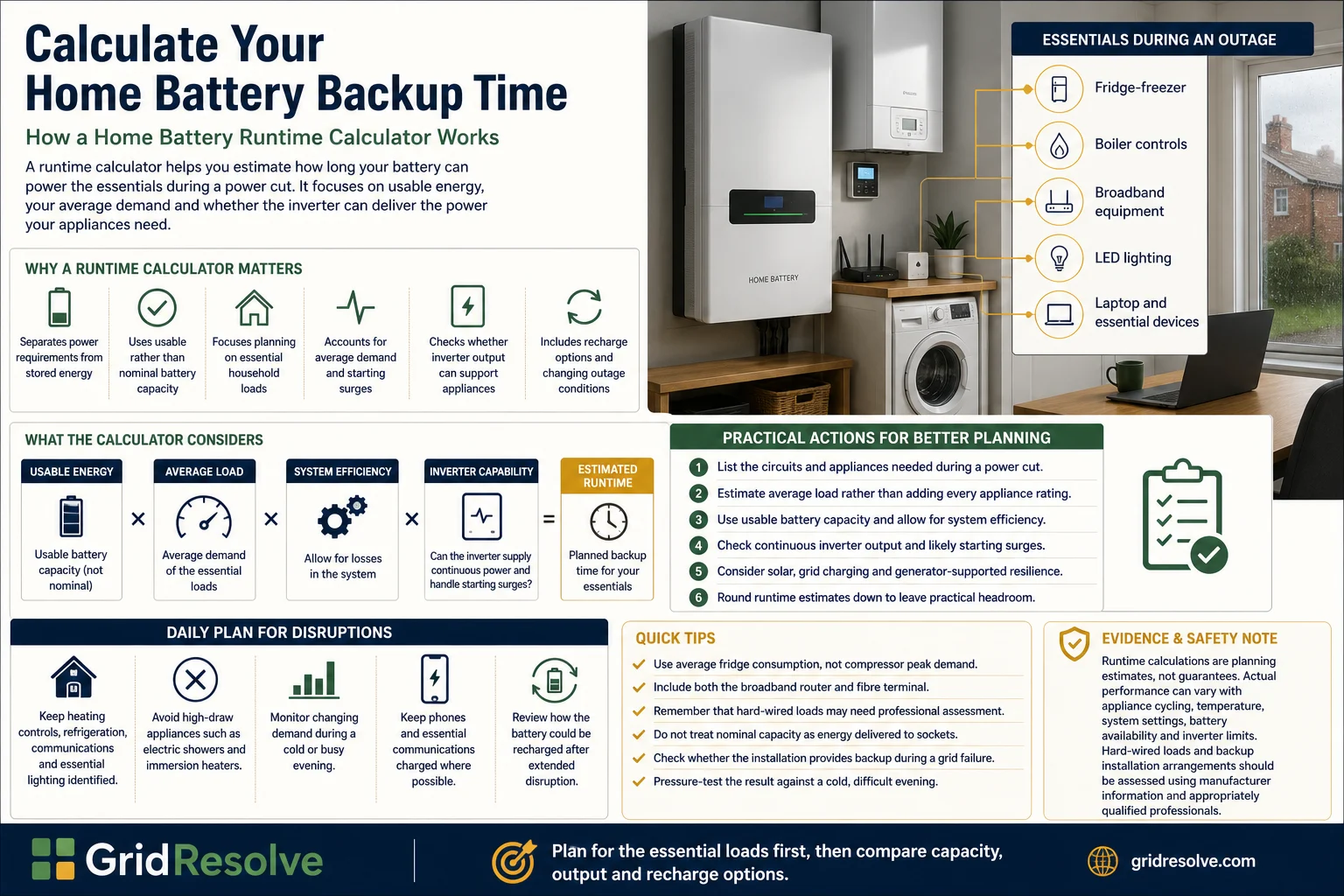
A power cut at 7pm does not test whether your battery looks impressive on a specification sheet. It tests whether the heating controls still work, the fridge stays cold, the broadband router remains online and there is enough light to move around safely. A home battery runtime calculator turns those practical needs into a realistic battery target.
The useful answer is rarely a single number. Runtime depends on which appliances are actually running, how often they cycle, how much stored energy the battery makes available and whether its inverter can handle the load at the moment it starts. Start with the problem. Then calculate the power required to solve it.
What a home battery runtime calculator should measure
A good calculator separates two figures that are often muddled together: power and energy.
Power is measured in watts (W) or kilowatts (kW). It tells you how much electricity your household needs at one time. Energy is measured in watt-hours (Wh) or kilowatt-hours (kWh). It tells you how much electricity is stored for use over time.
The basic calculation is:
`Runtime in hours = usable battery energy in Wh × system efficiency ÷ average load in W`
That formula is a sound starting point, but every term needs a sensible assumption. Use the battery’s usable capacity rather than its headline capacity, account for inverter losses, and base the load on real appliance use rather than the largest number printed on a label.
Usable capacity is not the same as advertised capacity
A battery described as 10 kWh may not deliver a full 10 kWh to your sockets. Manufacturers usually reserve a small portion of capacity to protect battery life, while the inverter and control equipment consume some energy during operation.
If a system has 10 kWh of nominal capacity but 9 kWh is usable, use 9 kWh in your calculation. If you then allow 90 to 95 per cent efficiency from battery to appliances, the energy available at the plug is closer to 8.1 to 8.55 kWh.
This is not a reason to distrust battery specifications. It is simply why comparisons need like-for-like figures. Nominal capacity, usable capacity and delivered energy are different measures.
Average load matters more than occasional peaks
A fridge might draw 100W while its compressor is running but far less over a full day because it cycles on and off. A gas boiler may use modest power for controls and pumps, yet its demand rises while firing. A kettle draws around 2 to 3kW, but only for a few minutes.
For runtime planning, use an average load across the outage period. For inverter sizing, also check the highest likely simultaneous load and any starting surge. A battery can have enough stored energy for a long outage but still fail to start a fridge compressor, pump or freezer if the inverter output is too low.
Build your essential-load profile first
Do not begin by adding every appliance in the house. During a power cut, most households can live without the oven, immersion heater, electric shower, tumble dryer and electric vehicle charging. Those loads can drain even a substantial home battery very quickly.
Instead, list the circuits and appliances that make the home safe and workable. For many UK households, that means heating controls, a broadband router and fibre terminal, fridge or freezer, a few LED lights, mobile phone charging and perhaps a laptop. If someone relies on medical equipment or an electrically powered water supply, those items need their own careful assessment.
A modest essential-load plan might look like this:
| Essential load | Planning average | Notes | |—|—:|—| | Broadband router and fibre terminal | 20W | Check both units, not just the router | | Gas boiler controls and pump | 80W | Varies with boiler operation | | Fridge-freezer | 60W | Average over time, not compressor peak | | LED lighting | 30W | A few occupied rooms | | Laptop and mobile phone charging | 60W | Home working or communications | | Total planning load | 250W | Excludes high-draw appliances |
The figures are examples, not a substitute for measuring your own equipment. Plug-in energy monitors can help with appliances that use a standard plug. Hard-wired loads, such as boiler circuits, may need assessment by a qualified electrician or information from the appliance documentation.
Be particularly cautious with heat. An electric fan heater, heat pump, electric cooker or hot-water immersion can consume more power in an hour than basic household essentials use over much of a day. A battery intended for resilience should not be assumed to provide whole-home normality.
A worked runtime calculation
Imagine a battery system with 5.12 kWh nominal capacity and 4.6 kWh usable capacity. Your essential-load profile averages 250W. Allowing 90 per cent battery-to-appliance efficiency gives:
`4,600Wh × 0.90 ÷ 250W = 16.6 hours`
That is a reasonable planning estimate, not a promise of exactly 16 hours and 36 minutes. The fridge may run more often in a warm kitchen. The boiler may be active for longer on a cold evening. A laptop could be swapped for a higher-power desktop computer. Battery output can also be affected by temperature and system settings.
For a more cautious plan, round the result down. Treat this example as roughly 14 to 16 hours of essential backup, then decide whether that covers your likely outage or whether you need more capacity, lower loads or another source of recharge.
Check output power before trusting the runtime result
Capacity answers, “How long?” Inverter output answers, “Can it run this at all?” Both matter.
A 5kWh battery paired with a 1kW inverter may offer useful overnight capacity for lights, broadband and refrigeration. It may not support a kettle while the boiler pump and fridge compressor are running. Conversely, a powerful inverter with a small battery may start demanding appliances but run out of energy quickly.
Look for continuous output in kW, short-duration surge capability and any limits that apply when the system is in backup mode. Some installations support only selected essential circuits during an outage. Others offer whole-home backup but may automatically shed non-essential loads. Neither arrangement is universally better. A dedicated essential-load board can make runtime more predictable, while whole-home backup can be more flexible if the household actively manages demand.
Include charging and outage patterns in the decision
A calculator should also prompt a second question: what happens after the battery runs down?
Solar can extend runtime, particularly from spring to early autumn, but its output during a winter power cut may be limited by short days, cloud and low sun angles. Do not count on a quoted annual solar yield as outage-day charging energy. A home battery that covers one night without solar may still be the right answer if local outages are normally brief. For longer or repeated outages, recharge options become more significant.
Grid charging can restore the battery between cuts, but it is unavailable during the outage itself. A generator can provide extended resilience where it can be operated safely outdoors and managed appropriately, though fuel, noise, emissions and maintenance are real trade-offs. Some households may prefer a hybrid plan: a battery for quiet, immediate backup and a generator only for prolonged disruption.
Common calculator mistakes to avoid
The most frequent error is using total household consumption. A home that averages 10 kWh per day does not necessarily need a 10 kWh battery for a day of backup, because normal consumption includes discretionary high-draw activities that can be paused.
The opposite mistake is being too optimistic. Do not assume a fridge consumes its lowest listed figure, a boiler never runs, or every battery kWh reaches the socket. Leave headroom for changing conditions and for the appliances you may genuinely need during an uncomfortable outage.
Also check whether the proposed system can operate during a grid failure. Not every solar-and-battery installation provides backup power automatically. Islanding protection, backup hardware, wiring configuration and installer design all determine what remains live when the grid goes down.
A useful calculation does not tell you to buy the biggest battery you can afford. It gives you a defensible requirement: the essential loads you need, the hours you want to cover, the output you require and the recharge plan that makes sense for your home. That is the point at which comparing batteries, portable power stations and generator-backed options becomes far clearer.
When you have your result, pressure-test it against an ordinary difficult evening: cold weather, a working fridge, heating demand, mobile phones to charge and someone needing the internet. A resilience plan that works on that evening is more valuable than a headline runtime figure.