
A power cut starts just before sunset. Your solar panels are still producing some electricity, the home battery has charge left, and a generator is available if the outage continues. Can you combine solar panels, a home battery and a generator for backup power? Yes, but the answer depends on how the equipment is connected and what you expect the system to do.
Each technology solves a different part of the problem. Solar panels can provide energy when daylight is available. A battery can deliver stored energy quietly and quickly. A generator can provide sustained power when the battery is low or solar production is poor. Combining them can create a flexible system, but it also introduces more equipment, controls and compatibility questions.
What each technology contributes
Solar panels are an energy source rather than a guaranteed backup supply. They can generate electricity during an outage only if the system has suitable equipment to operate safely without the grid. A standard grid-tied solar installation may shut down when the grid fails, even though the panels are receiving daylight. This prevents electricity being sent into a network that may be under repair.
A battery stores energy for later use. During a power cut, it can normally respond faster than a fuel generator and may be well suited to smaller, intermittent loads such as lighting, refrigeration, internet equipment and controls. Its useful contribution is measured in kilowatt-hours (kWh), while the inverter’s power rating is measured in kilowatts (kW). The first relates to how much energy is available; the second relates to how much demand can be supplied at once.
A generator produces electricity from fuel while it is running. That makes it valuable for a long outage, particularly when solar generation is limited and the battery cannot cover overnight demand. It can also recharge a battery if the system is designed to accept generator input. However, it needs fuel, ventilation, servicing and safe operation outdoors. A combustion generator must not be run inside a home, garage, basement, shed or another enclosed or poorly ventilated space because of carbon-monoxide risk.
Common ways to combine the equipment
Solar panels plus a home battery
This is the simplest combined arrangement. Solar energy supplies household loads and charges the battery when there is surplus generation. During an outage, a compatible backup inverter can form a local supply for the circuits selected for backup. The battery then covers demand when the panels are producing too little.
This arrangement is attractive for short outages and for households that want to use stored solar energy after dark. Its limitation is duration. Once the battery is depleted, continued backup depends on available solar generation. Cloud, short winter days, shading and household demand can all reduce the energy available for recharging.
It is also possible to have a home battery without solar panels. In that case, the battery is charged from the grid before an outage and discharged during the interruption. The article Is Home Battery Storage Worth It Without Solar Panels? looks at that arrangement in more detail.
Generator plus a home battery
A generator and battery can complement each other in a different way. The battery handles low and changing loads, while the generator runs when the battery needs recharging or when demand is too high for the battery inverter. This may reduce the time the generator operates, although the result depends on the controls, charging rate and load profile.
The battery can also make a generator-based system more convenient for short interruptions. Instead of starting the generator immediately, the battery may cover the initial period. Whether that happens automatically depends on the system’s changeover equipment and control settings.
Not every battery inverter can accept generator power. Some systems require a generator with particular electrical characteristics, a compatible controller or a defined connection method. A generator may also have a minimum operating load or behave poorly if the battery charger changes demand rapidly. These details need to be confirmed in the installation and manufacturer documentation.
Solar panels, a home battery and a generator
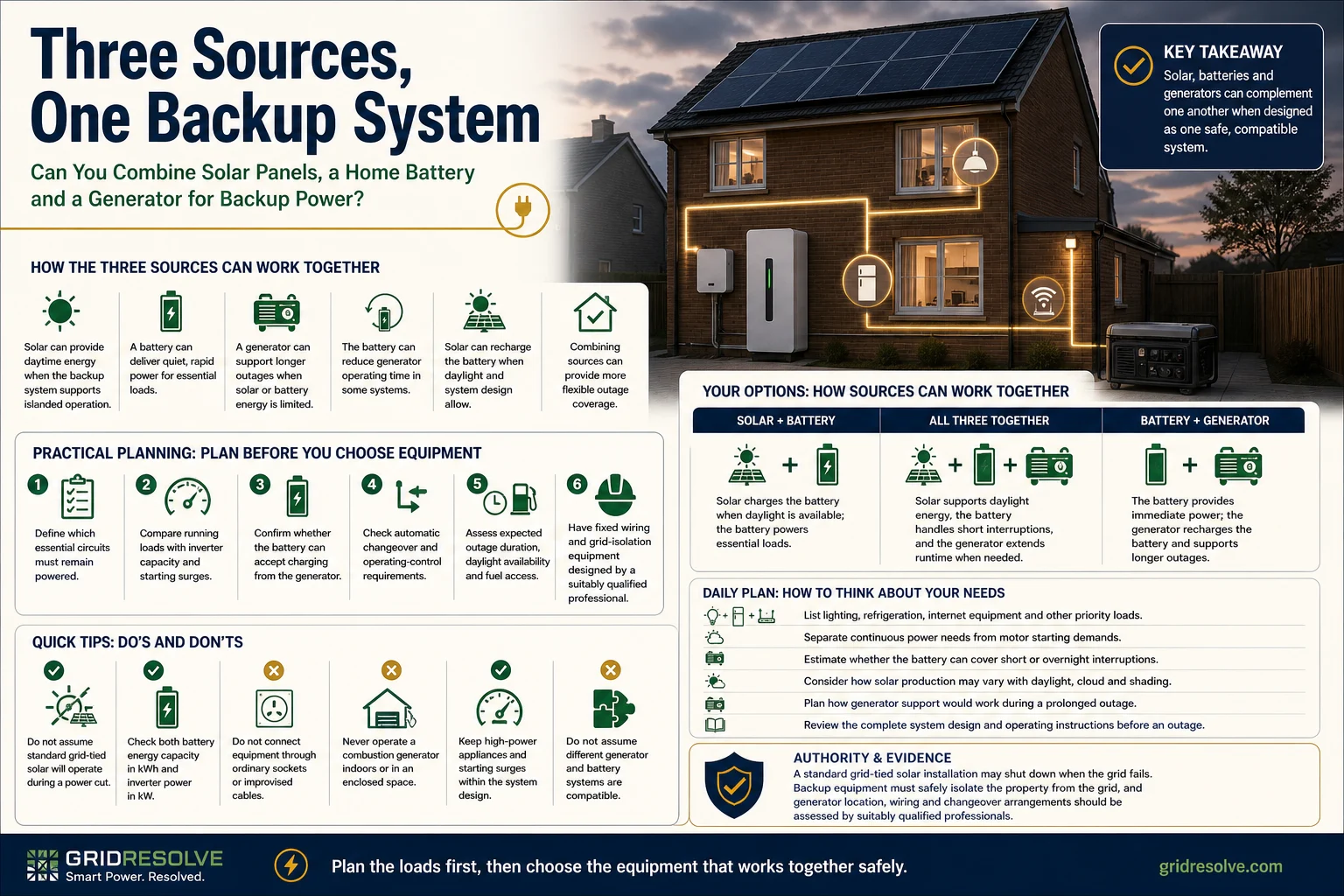
The three-way arrangement offers several potential operating modes. Solar can serve the home and recharge the battery in daylight. The battery can cover short periods, evening demand and brief generator start-up delays. The generator can support the backed-up circuits or recharge the battery during a prolonged outage.
That flexibility is useful where outages can last through the night, where sunlight is unreliable, or where keeping fuel consumption under control matters. It is less compelling if outages are rare and brief, the household only needs a small essential-load supply, or the solar-and-battery system already meets the practical requirement.
Adding a generator does not automatically make a solar-battery system suitable for every load. The inverter still has a maximum continuous power rating and a limit for short starting surges. A fridge compressor, pump or other motor may draw more power while starting than while running. Heating, cooking and hot-water appliances can also create substantial demand. The system must be designed around the loads that may operate together, not simply the total number of appliances in the house.
How the best combination changes with the outage
For a short outage, a battery may be the most useful part of the system. It can provide immediate power without the noise, fumes or manual attention associated with a generator. If the interruption ends before the battery is depleted, solar panels may be useful mainly for restoring charge afterwards.
For an outage lasting into the following day, solar becomes more valuable, provided the inverter can operate in islanded mode and the panels are connected to the backed-up system. The battery acts as a buffer: it can store some daytime production for the evening rather than requiring the home to use solar electricity at the exact moment it is generated.
For a multi-day outage, fuel availability and generator support become more important. Solar may reduce generator use during daylight, but it should not be treated as a fixed daily supply. A generator may provide an energy source during dark or heavily overcast periods, while the battery smooths the supply and covers smaller loads between operating periods.
Think about the actual load pattern as well as total energy. A battery may have enough usable energy for essential appliances but lack the inverter power to start a pump. A generator may have enough continuous output for those loads but still need checking against starting demand. For a structured way to separate power from energy, see watts versus watt-hours.
Compatibility questions to settle before choosing equipment
The most important question is whether the system can create a safe, isolated supply when the grid is down. Solar panels, batteries and generators cannot simply be connected together through ordinary sockets or improvised cables. A properly designed backup system needs equipment that separates the backed-up circuits from the grid and manages the permitted sources of power.
Ask an appropriately qualified installer to assess these points:
- Inverter capacity: Can the inverter supply the intended running loads and handle relevant starting surges? Check both continuous power and short-duration ratings.
- Charging routes: Can the battery be charged from solar, the generator, the grid, or a defined combination of these? Charging power and control limits matter.
- Automatic changeover: Will the system transfer between grid, battery, solar and generator automatically, or does it require a person to select a mode?
- Generator compatibility: Does the battery system recognise and accept the generator’s output? Check the permitted voltage, frequency, earthing arrangement and control interface in the documentation rather than assuming compatibility.
- Backup circuit design: Which circuits remain powered during an outage? A selected essential-load supply may be more practical than trying to keep the entire property energised.
- Operating logic: What happens when the battery reaches its reserve level, solar output changes suddenly or the generator runs at low demand?
- Safe generator location: Can the generator be positioned outdoors, away from doors, windows and vents, with enough space for safe exhaust dispersal and refuelling?
Fixed wiring, changeover equipment and any connection to a property’s electrical installation should be designed and installed by a suitably qualified professional. Do not attempt to backfeed a building or modify a consumer unit as a shortcut. If the system may supply a critical medical device, follow the device manufacturer’s guidance and seek advice from qualified electrical and clinical professionals rather than relying on a general backup arrangement.
When combining technologies is worthwhile
A combined system makes the strongest case when the household has several different priorities: immediate, quiet backup from a battery; daytime energy from solar; and longer-duration resilience from a generator. It can also be useful where fuel is available but expensive or inconvenient, because the battery and solar system may reduce generator operating time.
The case is weaker when the required backup is modest. If you only need a router, lights and refrigeration for occasional short cuts, a carefully specified battery system or a suitable portable solution may meet the need with less equipment. Conversely, if the household expects to run high-power loads for an extended period, a battery and solar array may not replace the energy supply provided by a properly designed generator.
Cost is not the only trade-off. More components mean more settings to understand, more interfaces to maintain and more possible points of failure. Batteries have usable-energy and operating-limit considerations; generators require fuel and maintenance; solar production varies with daylight and conditions. A system that looks comprehensive on paper can be less useful if nobody knows which loads it supports or how it behaves when one source is unavailable.
Can you combine solar panels, a home battery and a generator for backup power?
Yes, but the combination needs a system architecture that supports safe grid isolation, source coordination and the intended loads. Start by defining what must remain powered, how long an outage you are planning for and whether fuel and daylight are likely to be available. Then match the inverter, battery, solar equipment, generator and changeover controls as one system rather than buying each item independently.
For a household-focused starting point, the guide to keeping essential appliances running during a power cut can help you identify the loads worth prioritising before discussing a fixed installation with a qualified professional.
Frequently Asked Questions
Can a generator charge a home battery during a power cut?
It can, if the battery inverter, charger and generator are designed to work together. Compatibility is not universal. Check the manufacturer’s documentation and have the charging and changeover arrangement assessed as part of the installation.
Will solar panels work during a power cut if a generator is also connected?
They may, but only when the system has suitable islanding and control equipment. A conventional grid-tied solar inverter may shut down during an outage. The generator and solar inverter must also be coordinated so that the local supply remains within the equipment’s operating limits.
Is a battery or generator better for long power cuts?
There is no single answer. A battery can be convenient for immediate and shorter backup, while a generator may provide longer-duration energy if fuel is available. Solar can reduce reliance on either source in daylight. Compare the intended loads, usable battery energy, inverter power, sunlight, fuel storage and the maintenance you are prepared to manage.