

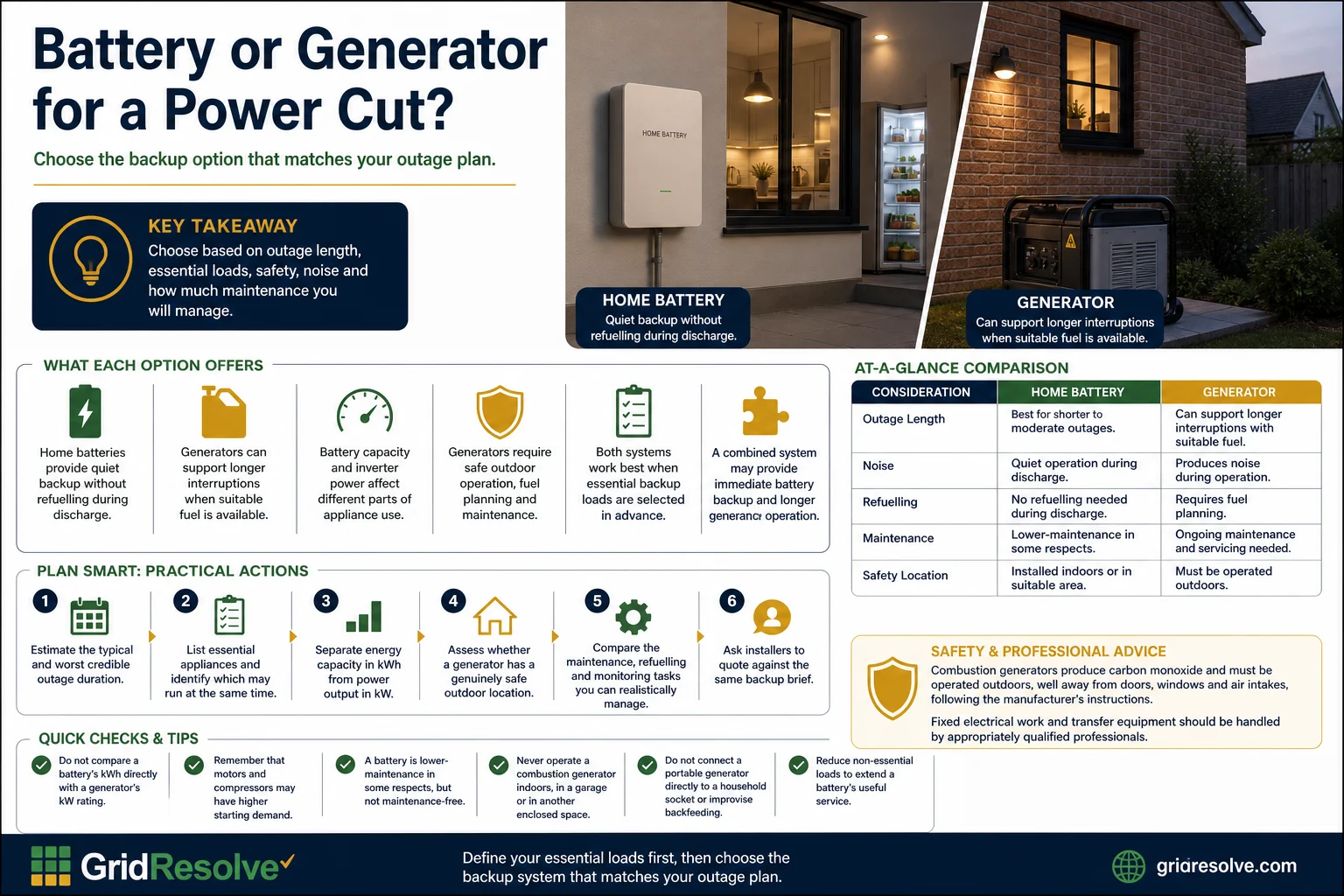
A short daytime power cut is a very different problem from a storm-related outage lasting several days. For the first situation, a home battery can keep lights, refrigeration, internet equipment and selected sockets running quietly with no refuelling. For the second, a generator may be easier to keep operating, provided you have suitable fuel, safe outdoor space and a properly planned electrical connection.
That is why the answer to home battery vs generator is not simply a matter of choosing the more powerful technology. The better option depends on how long outages last, which appliances matter, how much noise you will tolerate and whether you want an occasional backup system or something that can operate for extended periods.
How home batteries and generators work during a power cut
A home battery stores electrical energy in advance and supplies it through an inverter when the grid fails. Depending on the system, it may power the whole home or a selected set of circuits. The changeover can be automatic, but the exact behaviour depends on the battery, inverter and installation design.
A generator produces electricity while its engine is running. Petrol, diesel, LPG or another fuel may be used, depending on the generator and local availability. A portable unit normally supplies selected equipment through suitable connections, while a permanently installed system can be integrated into a home’s electrical supply by a qualified professional.
Neither option should be judged only by its headline capacity. A battery’s nominal capacity is measured in kilowatt-hours (kWh), which describes energy. Its inverter also has a power rating, measured in watts or kilowatts, which affects which appliances can run together. A generator is judged by its continuous output and, where relevant, its short-term starting or surge capability. Loads with motors and compressors can demand more power briefly than their normal running load.
Outage duration changes the comparison
For a brief outage, a battery is often the more convenient form of backup. It can respond quickly, does not need fuel handling and can cover essential loads without engine noise or exhaust. If the electricity returns before the stored energy is used, the system may require little attention from the household.
As an outage continues, the battery’s available energy becomes the limiting factor. Actual runtime depends on usable capacity rather than just the advertised nominal figure, as well as inverter losses, the average load, appliance duty cycles, temperature, battery age and any manufacturer limits. Running a fridge-freezer intermittently is a different demand from running an electric cooker, immersion heater or electric vehicle charger.
A generator has a different limitation: it can continue producing electricity while it has suitable fuel and receives the maintenance and operating conditions specified by its manufacturer. That makes it attractive for longer interruptions, but fuel storage, delivery and safe operation become part of the backup plan. Fuel may not be readily available during a widespread outage, and a generator is not a substitute for planning how much power the household actually needs.
For a closer look at the variables behind battery runtime, see how long a home battery can power a house during a power cut. The key point is that reducing the load can extend a battery’s useful service considerably, while a generator still needs enough capacity for both normal and starting demand.
Usable power, energy and appliance choice
Homeowners sometimes compare a battery’s kWh figure directly with a generator’s kW rating. They measure different things. Kilowatt-hours describe how much energy is available over time; kilowatts describe the rate at which power can be supplied.
A battery may have enough stored energy for several essential loads but an inverter that cannot support a large motor starting or several high-power appliances at once. Conversely, a generator may have a strong output rating but consume fuel quickly if asked to support substantial loads continuously.
Start by identifying the appliances you want available during an outage, then consider which may operate at the same time. Refrigeration, lighting, communications equipment and some heating controls may be priorities. Cooking, laundry, hot water and space heating can place a much heavier demand on either system. Check appliance data plates and manufacturer specifications rather than relying on generic wattage tables.
For detailed generator load planning, the guide to choosing a generator size for a house covers running demand and starting demand separately. This article stays at the comparison level: a battery and a generator both work best when the backup loads have been deliberately chosen.
Noise, emissions and everyday convenience
Noise is one of the clearest differences. A battery has no combustion engine, so it does not create engine noise while supplying power. It may still produce sounds from cooling equipment or other electronics, depending on the design and installation. A generator creates mechanical and exhaust noise, and the perceived level varies with the model, enclosure, load and distance from the home.
Generators also produce combustion emissions, including carbon monoxide. A combustion generator must never be operated indoors, in a garage, basement, shed or another enclosed or poorly ventilated space. Keep it outdoors and well away from doors, windows and air intakes, following the manufacturer’s placement instructions. Carbon monoxide can build up in or enter a building even when a door is open.
A battery avoids local combustion emissions during discharge. That does not make every battery installation risk-free: batteries contain stored electrical energy and may require appropriate protection, clearances and thermal management. Use the manufacturer’s installation requirements and have fixed electrical work completed by an appropriately qualified installer.
Convenience also includes starting and refuelling. A battery does not need a fuel can, engine oil or manual starting routine, but it must have sufficient charge before the outage and may need a strategy for preserving energy. A generator may run for as long as fuel and operating conditions permit, but someone may need to monitor it, refuel it and manage shutdowns safely.
Maintenance and reliability between outages
Generators contain engines and moving parts. They generally need periodic checks, servicing and attention to fuel condition, oil and starting systems. The exact schedule varies by fuel type, design and manufacturer. A generator that sits unused for long periods may not be ready when an outage occurs unless it is maintained and tested in accordance with its instructions.
Batteries have fewer moving parts and do not require engine servicing. They still need monitoring, suitable environmental conditions and attention to system warnings or faults. Usable capacity and performance can change with age, temperature, settings and the manufacturer’s operating limits. A battery is therefore lower-maintenance in some respects, not maintenance-free in every circumstance.
Infrequent outages can make this distinction especially important. A household that rarely loses power may value a system that is ready without fuel management, while another household may prefer a generator because it can provide longer operation when a major interruption does occur. Consider the maintenance task you are genuinely likely to carry out, not just the feature list.
Installation, ventilation and electrical safety
Both technologies need more than a box placed beside the house. A battery installation may involve a battery enclosure, inverter, protective equipment, isolation arrangements and a defined backup circuit or changeover system. The installer needs to confirm that the equipment is compatible with the home’s electrical design and the intended loads.
A fixed generator installation may require an approved location, safe exhaust routing, fuel arrangements, weather protection and a suitable transfer system. The transfer arrangement is essential because a generator must not be connected in a way that can feed electricity back into the grid. Do not improvise connections, alter a consumer unit or attempt backfeeding. Fixed wiring, transfer equipment, fuel plumbing and related work should be assessed and completed by appropriately qualified professionals.
Rules for electrical work, fuel storage, noise, clearances and planning vary by location. Check current local requirements and the equipment manufacturer’s instructions before buying. A professional assessment is particularly useful if you want whole-home backup, have limited outdoor space or intend to connect a permanent generator.
For a broader essentials-first approach, this guide to keeping essential appliances running during a power cut can help you define what the system actually needs to do.
Home battery vs generator: which priorities point where?
Choose a home battery when quiet operation, low day-to-day involvement and rapid automatic backup matter most. It can suit households that mainly want to bridge short outages and protect a selected set of essential appliances. It is also a strong fit where storing fuel or placing a combustion engine outdoors would be difficult.
A generator may suit you better when long-duration backup is the main priority, especially if the home has a suitable, safe outdoor location and a realistic fuel plan. It can be more practical for households that need extended operation rather than a limited reserve of stored energy. That advantage comes with noise, emissions, maintenance and refuelling responsibilities.
If outages are uncommon, weigh the ownership routine as carefully as the outage performance. A generator may offer reassuring duration but demand periodic attention. A battery may be easier to live with but have a finite reserve during a prolonged cut. There is no universal winner because the costs, installation constraints and household loads differ.
Could a combined system be the better answer?
Some households may benefit from using a battery for immediate, quiet backup and a generator for a longer interruption. The battery can cover short disturbances and selected loads while avoiding immediate engine use; the generator can provide another source of power if the outage continues. Whether this arrangement is practical depends on compatibility, controls, installation design and local requirements.
A combined system also adds equipment, planning and maintenance. It should not be assembled by trial and error. Ask an appropriately qualified installer to explain how the sources would be isolated, controlled and protected, and which loads each one is intended to support.
A practical decision framework
Before requesting quotes, write down answers to five questions:
- How long do your typical and worst credible outages last?
- Which appliances must remain available, and which can wait?
- Is quiet, automatic operation more valuable than extended fuel-based running?
- Do you have a genuinely safe outdoor location for a generator?
- Will you maintain fuel, engine equipment or battery systems as required?
Then ask installers to quote against the same backup brief rather than comparing unrelated headline ratings. Request the usable battery energy and inverter output for a battery system, or the continuous and surge capabilities for a generator. Ask what circuits will be backed up, how the system changes over during a cut and what routine checks are expected.
The best next step is to make an essentials list and inspect the appliance data plates before choosing a technology. That gives you a realistic brief for a qualified installer and makes the home battery vs generator decision based on your actual power cuts, not a generic promise of backup.
Frequently Asked Questions
Is a home battery quieter than a generator?
Usually, yes. A battery has no combustion engine, although its inverter or cooling equipment may make some sound. A generator produces engine and exhaust noise, with the level depending on its design, load and location.
Can a generator run for longer than a home battery during a power cut?
It may be able to, because it can continue generating while it has suitable fuel and is operated within its manufacturer’s limits. A battery is limited by its usable stored energy unless it has a permitted way to receive further energy. Actual duration for either option depends on the connected load and operating conditions.
Can I connect a portable generator directly to a household socket?
Do not use improvised connections or attempt to backfeed a property. Unsafe connections can energise wiring unexpectedly and create serious shock, fire and grid-worker hazards. Ask an appropriately qualified professional about a suitable transfer or connection method for your home and local requirements.