

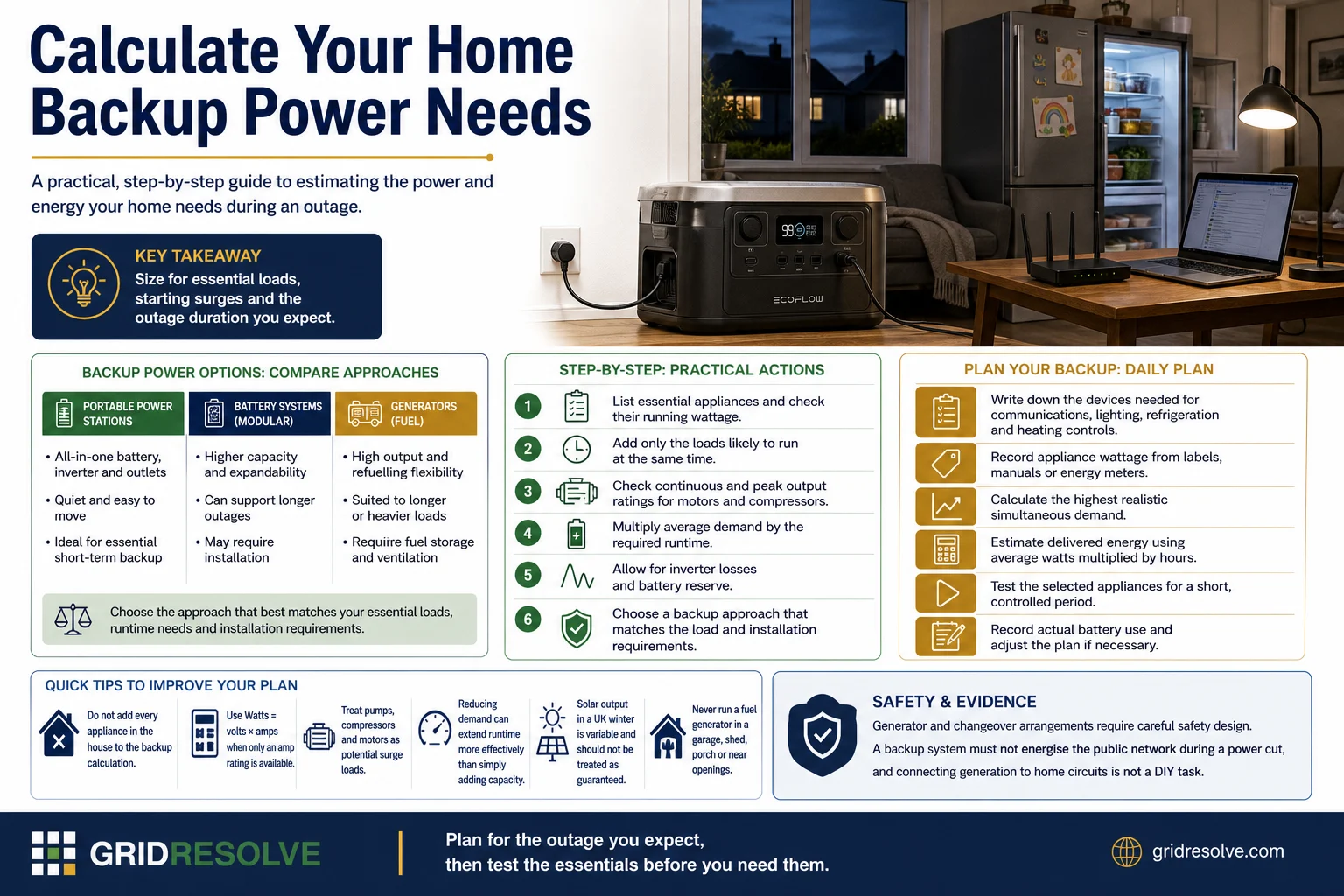
A power cut does not require you to keep the whole house running. It requires you to decide what must stay on, for how long, and what you are prepared to manage while the grid is down. To calculate home backup power properly, start with those household priorities rather than a generator or battery size advertised on a product page.
For most UK homes, the first priorities are modest: broadband, a few lights, mobile phone charging, refrigeration and the controls that allow a gas or oil boiler to operate. The calculation becomes more demanding when you add a freezer, sump pump, medical equipment, induction hob, electric heating, well pump, electric vehicle charging or a full home-office setup. Each changes the type of backup system that makes sense.
Want to calculate your requirements without doing everything manually? Use the GridResolve Backup Power Calculator to select the appliances you need during a power cut and estimate the output and backup capacity your household requires.
Calculate home backup power in two parts
Every backup plan has two separate numbers: power and energy.
Power is measured in watts (W) or kilowatts (kW). It is the rate at which electricity is being used at any one moment. Your backup system needs enough output power to run the appliances that may operate together.
Energy is measured in watt-hours (Wh) or kilowatt-hours (kWh). It is the total quantity of electricity required over time. This determines how long a battery will last, or how much fuel a generator will use.
A useful way to remember the difference is that power is the size of the tap, while energy is the amount of water in the tank. A large battery with a low-output inverter may run for many hours but still fail to start a pump. A powerful generator may run demanding loads but need regular refuelling during a long outage.
Step 1: Define your essential loads
Write down what you genuinely need during a cut. Be strict at this stage. Planning for essentials usually produces a quieter, cheaper and easier-to-run system than trying to recreate normal household life.
A typical essential-load plan might include a router and fibre equipment, LED lighting, a fridge-freezer, mobile phone charging, television or radio, laptop charging and boiler controls. If someone works from home, reliable broadband, a laptop and perhaps one monitor may be non-negotiable. In a rural property, a private water pump or sewage system may be more important than entertainment.
Do not assume that every appliance is suitable for every form of backup. A standard electric oven, immersion heater, kettle, tumble dryer, electric shower and portable electric heater use substantial power. They can quickly turn a sensible resilience plan into one requiring a large generator or an expensive, professionally installed battery system.
Use appliance labels, manuals, plug-in energy meters or manufacturer specifications to find running wattage. Where only amps are stated, a reasonable UK estimate is:
Watts = volts × amps
Using a nominal mains voltage of 230V, a device rated at 2A uses roughly 460W. This is an estimate, not a guarantee, but it is useful for early planning.
| Essential load | Typical running power | Planning note | |—|—:|—| | Broadband router and fibre terminal | 15-30W | Often overlooked, but low demand | | LED lights | 5-12W each | Count only the rooms you need | | Laptop | 40-100W | Higher when charging and under load | | Fridge-freezer | 80-200W | Compressor cycles on and off | | Gas boiler controls and pump | 80-200W | Boiler compatibility needs checking | | Television | 50-150W | Varies greatly by screen size | | Sump or water pump | 400-1,500W+ | May have a high starting surge |
These figures are planning ranges, not product promises. Your own appliances, particularly older refrigeration and pumps, may differ significantly.
Step 2: Add the loads that run at the same time
Next, calculate the highest realistic simultaneous demand. You do not add every item in the house. You add the items likely to be operating together at the moment your demand peaks.
Imagine this winter scenario: router and fibre equipment at 25W, six LED lamps at 60W, fridge-freezer at 150W, boiler controls at 150W, a laptop and monitor at 120W, and television at 100W. The total running demand is 605W.
That does not mean a 605W power station is automatically sufficient. Inverters should not be operated continuously at their maximum rating, and refrigeration compressors or pumps can briefly draw far more power when starting. Allowing a margin of around 25 to 50 per cent is often sensible for a basic essential-load plan. In this example, an inverter rated at 1,000W continuous output would offer more practical headroom than one rated at 600W.
Account for starting surges
Motors, compressors and pumps may need a short burst of extra power at start-up. This is commonly called surge, peak or starting power. A fridge may run at 150W but briefly demand several times that figure as its compressor starts. The same issue can apply to central-heating pumps, pressure pumps, power tools and some older appliances.
Check both the continuous output and peak output of a portable power station, inverter or generator. Also check how long its peak rating is available for. A headline peak figure that lasts only a fraction of a second may not start a demanding appliance reliably.
If a pump is essential, base the system around the pump rather than treating it as an add-on. It may determine the required inverter size even when the rest of the household load is small.
Step 3: Calculate battery capacity for the outage you expect
Once you know your likely average load, multiply it by the hours you need to cover:
Energy needed (Wh) = average load (W) × runtime (hours)
Suppose your essential loads average 300W over an eight-hour evening and overnight outage. You need 2,400Wh, or 2.4kWh, of delivered energy.
Do not buy a battery based only on its quoted capacity. Some of its stored energy is unavailable because of inverter losses, battery protection, temperature and reserve settings. A portable power station rated at 2kWh may provide less than 2kWh at its AC sockets. For planning, allowing roughly 10 to 20 per cent for losses is prudent, although the real figure depends on the equipment and load.
For the 2.4kWh example, a nominal battery capacity of around 2.7 to 3.0kWh is a more realistic starting point. If you expect a 24-hour outage rather than eight hours, the required capacity rises quickly. At 300W average demand, it becomes 7.2kWh delivered energy before allowing for losses.
This is why reducing demand often matters more than adding capacity. Switching off a television, using fewer lights, delaying laptop charging and avoiding unnecessary appliance use can extend runtime meaningfully.
Step 4: Match the result to the right backup approach
The numbers tell you what is possible, but they do not select a technology on their own.
A small portable power station suits short cuts and low-demand essentials, especially in a flat or terraced home where generator noise, fumes and outdoor placement are impractical. It can keep communications, lighting and selected electronics running quietly, but it is unlikely to support whole-home circuits or long periods of high demand.
A larger battery with an appropriately rated inverter can support more circuits and may be paired with solar. Solar can help during multi-day outages, but winter output in the UK is variable and should not be treated as guaranteed emergency generation. A battery charged from solar still needs enough stored capacity to get through dark hours and poor weather.
A petrol, diesel or LPG generator can provide high output for longer periods if fuel is available, making it useful for rural homes, pumps or extended outages. The trade-offs are noise, emissions, refuelling, maintenance and safe outdoor siting. It must never run in a garage, shed, porch or close to doors, windows and air vents because carbon monoxide can be fatal.
A professionally installed home battery or generator changeover system can supply selected circuits automatically, but installation design matters. UK homes must not be connected to backup generation in a way that can energise the public network during a power cut. This is not a DIY connection job.
Step 5: Test the plan before you rely on it
Paper calculations are a starting point. Run a controlled test on the appliances you intend to support. Check whether the fridge starts, whether the boiler behaves correctly and whether broadband returns after a brief interruption. Some heating systems, particularly those with sensitive controls, may need an electrician’s advice before being supplied by a portable inverter.
Record actual battery use over a few hours. Your average load may be lower than expected because appliances cycle, or higher because chargers, monitors and standby equipment quietly add up. Test in conditions close to the ones you are planning for, including colder weather if heating controls or pumps are part of the plan.
The most useful backup calculation is not the largest number you can justify. It is the one that keeps your household safe, connected and reasonably comfortable for the outage you are most likely to face, without buying capacity or complexity you will rarely use.