
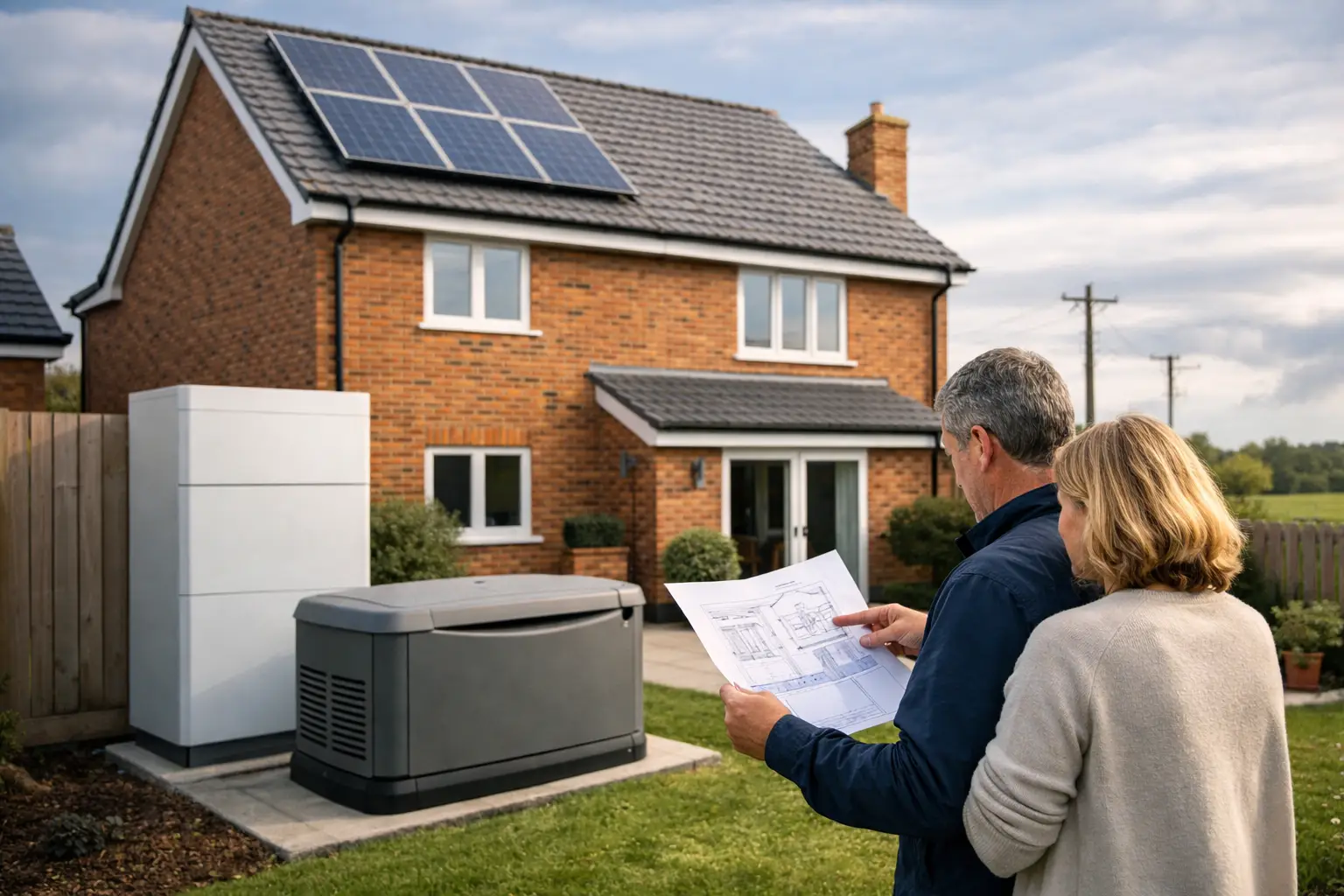
A power cut rarely affects just one appliance. The broadband router goes off, the fridge starts warming, the heating controls stop responding and a home office may be unusable within minutes. Whole house backup planning puts those consequences in order before you spend money on a battery, generator or solar system.
The phrase can be misleading. For some households, “whole house” means every circuit works exactly as normal. For others, it means the essentials remain available: heating controls, refrigeration, lighting, internet, phone charging and a few sockets. Those are very different requirements, with very different costs. Start with the problem. Then choose the technology.
Define what whole house backup planning means for you
First, decide whether you need full-property backup or an essential-loads setup. Full-property backup can support most or all circuits, subject to the system’s output. It is convenient, but it must be sized for unpredictable demand from appliances such as ovens, showers, kettles, tumble dryers and electric heating.
An essential-loads arrangement supplies only selected circuits or sockets during an outage. This often covers the practical needs of a UK home at a fraction of the power and battery capacity required for every appliance. It also makes it easier to prevent someone from accidentally switching on a high-demand appliance while the supply is limited.
There is no universally correct choice. A household with medical equipment, a sump pump or an all-electric heating system may have a stronger case for broader coverage. A family mainly concerned about short evening cuts may be well served by a modest backup circuit for the boiler, fridge, lights and broadband.
Build a load list before comparing equipment
Power and energy are related but separate planning questions. Power, measured in watts or kilowatts, is what the system can supply at one moment. Energy, measured in kilowatt-hours, determines how long it can supply that demand.
Write down each appliance you want available in an outage, its running power and the number of hours you expect to use it. Manufacturer labels, plug-in energy meters and appliance manuals can help. Use sensible allowances where figures are uncertain, particularly for refrigeration and pumps.
A typical essential-loads plan might include a fridge-freezer, broadband equipment, several LED lights, phone charging, a television or laptop, and gas-boiler controls. Their average combined demand may be fairly modest. However, the highest demand can occur when the fridge compressor starts, a pump runs or a kettle is used. Motors and compressors can draw a brief starting surge above their normal running power.
Do not simply add every nameplate figure and assume that is your requirement. Consider what can realistically run together, but do not understate the result either. A 3 kW kettle, for example, can dominate a small backup system even though it is used for only a few minutes. Electric showers, immersion heaters, induction hobs, heat pumps and EV chargers generally change the calculation substantially.
A simple worked example
Suppose your planned outage load averages 350 W: refrigeration cycling, router, lights, a laptop and boiler controls. Over 12 hours, that is roughly 4.2 kWh of energy at the appliances. After allowing for inverter losses and a margin, a battery with around 5 kWh of usable stored energy may be a sensible starting point.
But that same home might still need 2 kW or more of inverter output to handle coincident loads and starting surges. Capacity alone does not tell you whether the system can run the appliances. Check both usable kWh and continuous and peak output in kW.
Set a realistic outage duration
Planning for a two-hour interruption is not the same as planning for a winter day without supply. Think about the outages your area actually experiences, including seasonal weather, rural network faults and how long repairs have taken in the past.
For short cuts, a portable power station may cover communications, lighting and selected appliances with little installation work. For overnight resilience, a larger battery or generator may be more suitable. For multi-day outages, the ability to recharge or refuel becomes central. A battery eventually needs a charging source; a generator needs fuel stored and handled safely.
Solar can extend battery runtime, especially from spring to autumn, but it should not be treated as a guaranteed winter outage solution. Output depends on daylight, weather, roof orientation and the season. A solar array also needs compatible battery and inverter equipment that can operate safely when the grid is down. Not every solar installation can do this automatically.
Match the technology to the constraint
Home batteries are quiet, automatic and suitable for indoor electrical installation when professionally specified. They are often a strong option for households wanting low-disruption backup for essentials or selected circuits. Their limits are upfront cost, finite stored energy and the output needed for larger loads.
Portable power stations offer a lower-commitment route for renters, occasional use or a first resilience step. They can be useful for a router, lighting, laptops and some refrigeration, but their output and capacity can be restrictive. They also require deliberate appliance connection unless paired with an appropriately installed changeover arrangement.
Petrol, diesel or LPG generators can provide high output and can run for extended periods with refuelling. They bring trade-offs: noise, emissions, fuel storage, maintenance and manual operation. A generator must operate outdoors, well away from doors, windows and vents. Never run one in a garage, shed or other enclosed space, even with doors open.
Hybrid systems combine battery storage with a generator, solar or both. They can make sense where outages are prolonged but silent overnight operation is valued. The extra flexibility comes with more equipment, more control settings and a more involved design.
Electric-vehicle backup is another emerging option. Some vehicles and chargers can power appliances, while vehicle-to-home systems can potentially support circuits. Compatibility, installation requirements and UK availability vary considerably, so treat this as a specific technical assessment rather than an assumed feature of owning an EV.
Plan the changeover, not just the power source
The safest backup equipment is of little use if it cannot be connected properly when the mains fails. A fixed battery or generator arrangement usually needs a changeover device that isolates your home from the public network during backup operation. This protects electricity network workers and prevents dangerous back-feeding.
Do not attempt to power house circuits by plugging a generator into a normal socket. This is unsafe and can energise wiring beyond your property. Fixed work should be designed and installed by a competent electrician, with the relevant requirements for earthing, circuit protection, islanding and any distribution network operator notification addressed.
Ask early whether you want automatic changeover or are content with manual intervention. Automatic backup is valuable for heating controls, internet equipment, security systems and any load that should not lose power for long. Manual systems can cost less, but someone must be present, know the procedure and be able to carry it out safely.
Test the uncomfortable details
A credible plan includes winter conditions, not just a neat specification sheet. If your gas boiler has electrical controls, pumps or a condensate pump, test whether the proposed system starts and runs them correctly. If you have a heat pump, establish its true starting and running demand rather than assuming it can be treated like a gas boiler.
Consider where equipment will sit, how it will be ventilated, who will maintain it and how it will be used after dark. Generator fuel has a shelf-life and needs sensible storage. Batteries have temperature limits and may reduce output or charging performance in cold conditions. Portable units need to be kept charged and accessible, not left flat at the back of a cupboard.
Finally, rehearse the outage. Turn off the mains supply using the planned changeover method, check the selected circuits, and see what happens when the fridge starts or the boiler calls for heat. A test often reveals small but consequential omissions, such as the router being on a non-backed-up socket or an external pump being left off the essential circuit list.
The best plan is not the one with the largest headline number. It is the one that keeps the right parts of your home working for the length of outage you are likely to face, without creating a safety, noise or maintenance problem you will regret later.