
A generator is only useful for as long as you can fuel it safely. That is where dual fuel generator benefits can be meaningful for UK households: a compatible generator can run on petrol and LPG, giving you a second practical route to electricity when a power cut lasts longer than expected. It is not a guarantee of uninterrupted power, and it does not remove the need for sensible load planning. But it can make a backup plan less dependent on one fuel supply.
For a household trying to keep the boiler controls, fridge-freezer, broadband router, lights and a few sockets running, fuel flexibility can be more valuable than chasing the largest generator rating. Start with the problem. How much power do your essential appliances need, for how long, and where will the generator operate? Then decide whether dual fuel genuinely improves the plan.
What is a dual fuel generator?
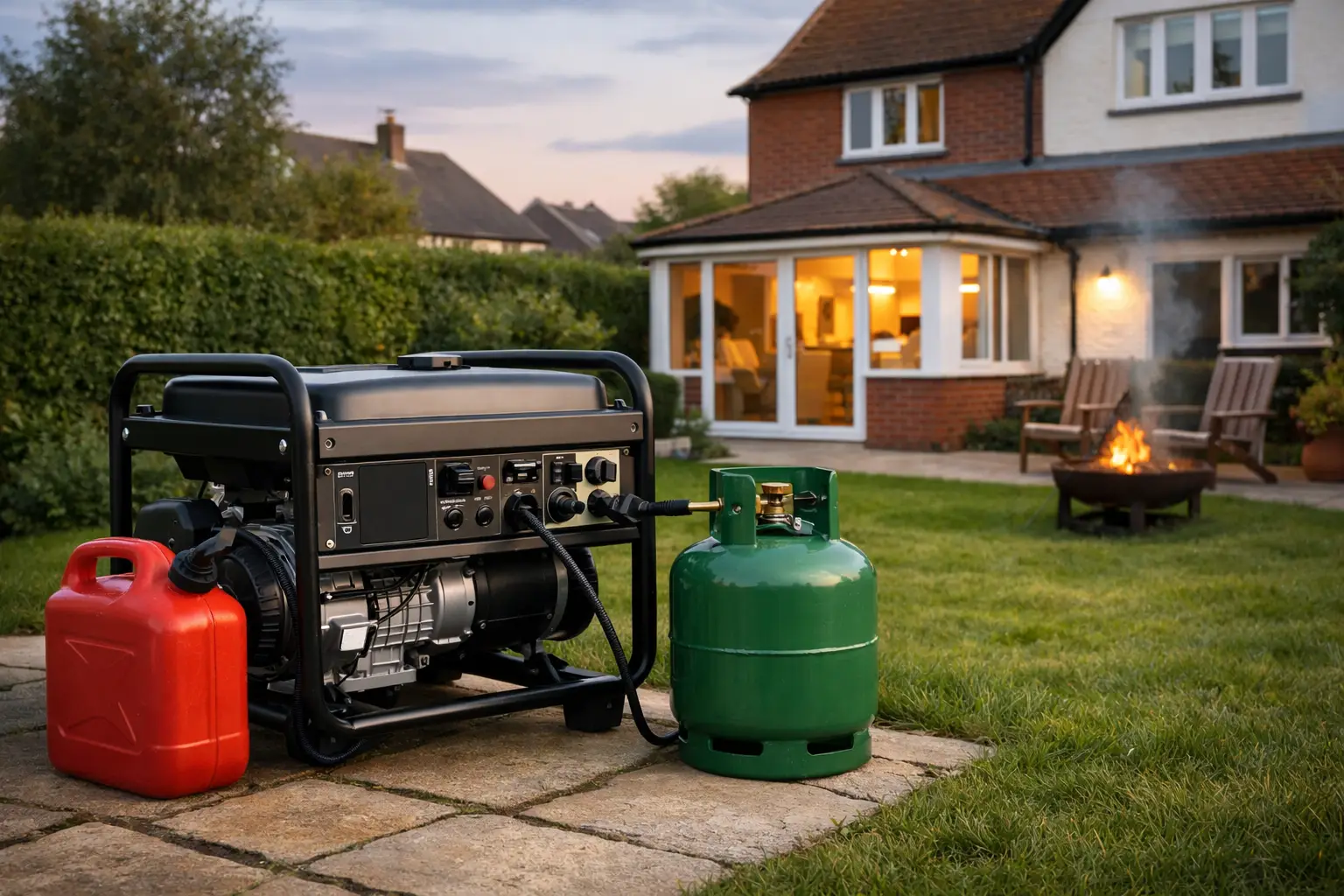
Most portable dual fuel generators sold for domestic use run on unleaded petrol or LPG. LPG may be supplied from a portable propane cylinder, a larger bottle arrangement or, in some cases, a fixed bulk tank connection installed for that purpose. The generator uses one fuel at a time, rather than blending both fuels together while running.
This is distinct from a diesel generator with a second fuel source, or a hybrid battery-and-generator system. It also does not mean any petrol generator can safely be connected to a gas bottle. The engine, regulator, hose and controls must be designed and approved for LPG operation.
The detail matters because the headline generator output can differ by fuel. A model rated at 3 kW on petrol may deliver less on LPG. Check both its continuous running output and its short-term maximum output on the fuel you expect to use most often.
The main dual fuel generator benefits
A second fuel option during a prolonged cut
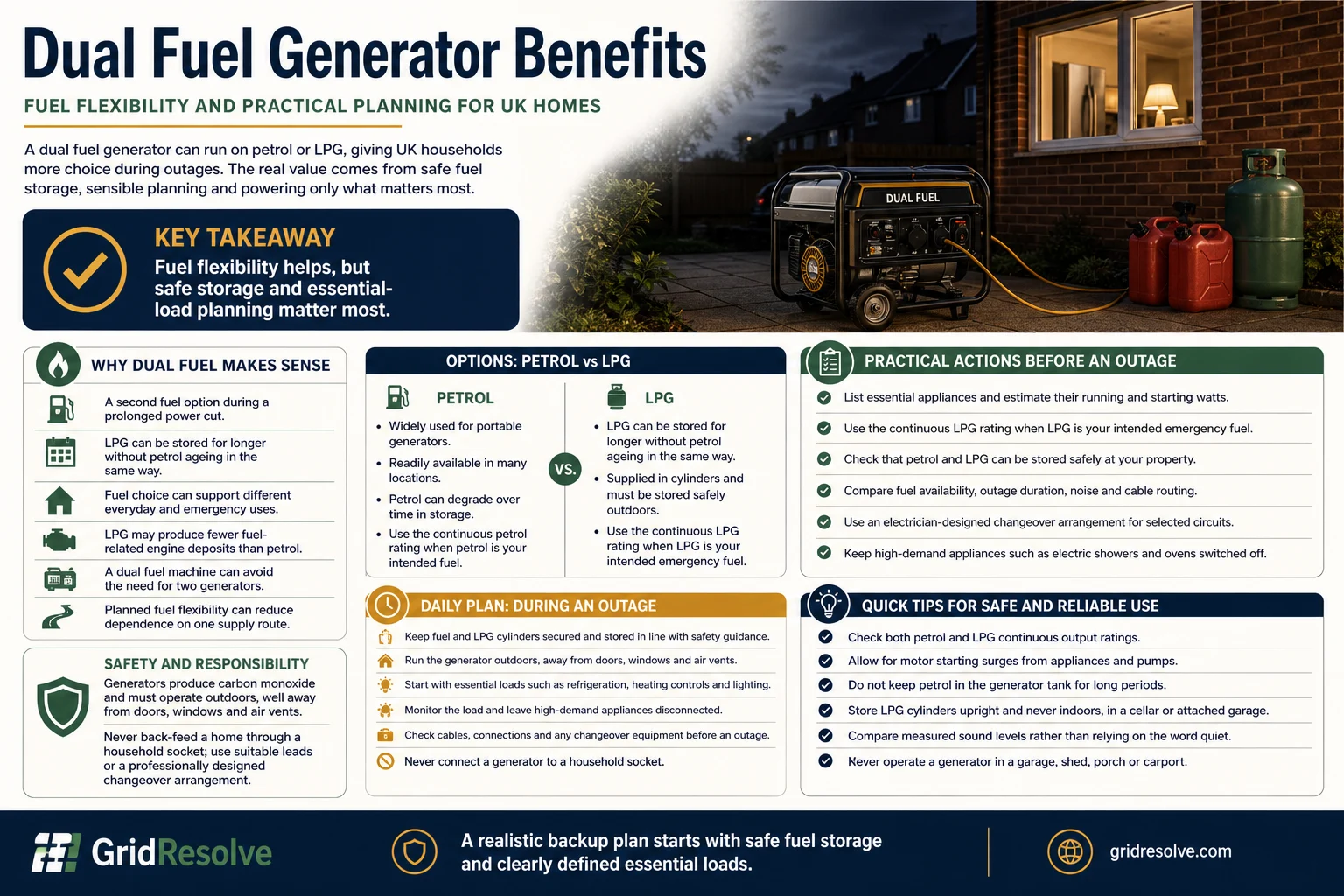
The clearest advantage is resilience against a single fuel problem. Petrol stations may be busy, closed or unable to dispense fuel during a local disruption. Petrol stored at home also has a limited useful life unless managed carefully. LPG cylinders, by contrast, are sealed and can be stored for far longer when kept upright, outdoors and in accordance with safety guidance.
That does not mean LPG will always be easy to obtain. Cylinder availability varies by supplier and area, especially during high demand. The benefit comes from holding a sensible reserve in advance, not assuming fuel will be available after an outage begins.
For rural properties, where a power cut can affect a wider area for several days, this second option can be particularly reassuring. A household with a planned LPG supply can continue running essential loads without repeated petrol trips, provided the generator and cylinders are correctly sized.
More manageable fuel storage for some households
Petrol needs suitable approved containers, secure storage and rotation. It should not be kept for long periods in the generator tank, and stale fuel is a common reason portable generators fail when they are finally needed.
LPG removes the fuel-age issue. A stored cylinder does not degrade in the same way as petrol, which can simplify preparedness for people who only expect occasional outages. It may also reduce the number of times you need to decant fuel into the generator.
There are trade-offs. LPG cylinders are bulky, heavy and must never be stored in a cellar, indoors or in an attached garage. You also need to confirm the cylinder type, regulator and hose connection specified by the generator manufacturer. Storage is simpler in one respect, not simpler in every respect.
Potentially cleaner-running fuel at the generator
LPG generally burns more cleanly than petrol, producing fewer fuel-related deposits in the engine. For an owner who uses a generator regularly, that may support cleaner operation and reduce some fuel-system maintenance concerns.
It is not an emissions-free choice. LPG generators still produce carbon dioxide and dangerous exhaust gases, including carbon monoxide. The generator must always run outdoors, well away from doors, windows, air vents and neighbouring properties. Never operate one in a garage, shed, porch, carport or other partly enclosed space, even with the door open.
Noise is another limitation that fuel choice does not solve. A conventional open-frame generator can be intrusive whichever fuel it uses. If you live close to neighbours, compare measured sound levels, not just labels such as “quiet”.
Flexibility between everyday use and emergency reserve
Some households use petrol for occasional garden, workshop or off-grid tasks and keep LPG as the outage reserve. Others do the reverse, using LPG as the normal fuel and retaining petrol for temporary flexibility. A dual fuel machine allows that choice without buying and maintaining two generators.
This can be useful where the household already has LPG for cooking, heating or a motorhome. However, do not assume an existing domestic LPG installation can supply a portable generator. A fixed-tank connection needs an appropriate, professionally assessed arrangement. Improvised connections are not safe.
Where the benefits are easily overstated
A second fuel does not make a generator automatically suitable for whole-house backup. The limiting factor is often output, not runtime. Electric showers, electric ovens, kettles, immersion heaters, heat pumps and tumble dryers can draw more power than a modest portable generator can provide. Motors in fridge-freezers, pumps and some heating equipment can also demand a brief starting surge.
A practical outage plan usually separates essential circuits from high-demand appliances. For example, a home may support heating controls, the circulation pump, refrigerator, broadband, lighting and selected sockets, while leaving cooking appliances and electric heating off. This reduces fuel use as well as avoiding overloads.
LPG output can be lower than petrol output, so calculate against the LPG continuous rating if LPG is your intended emergency fuel. A generator that appears adequate on its petrol specification may be marginal once the fuel changes and appliances start cycling on.
Cost is also mixed. LPG can be convenient for long-term storage, but cylinder deposits, refill pricing and delivery arrangements vary. Petrol may be easier to buy in small quantities, yet it requires disciplined rotation. The better option depends on local supply, your storage space, likely outage duration and how often you expect to test the machine.
Plan the generator around essential loads
Before comparing generator types, make a short running list of what must stay on during a cut. Add the normal watts for each item, then allow extra headroom for motor starting loads and future changes. Do not size a generator from the total number of sockets in the house.
A typical essentials-only plan might include a fridge-freezer, boiler controls and pump, router, a few LED lights, phone charging and one home-office setup. Its normal demand can be modest, but the generator must cope with appliances switching on at different times. A larger property with a private water pump, sewage pump or oil-fired heating system needs more careful assessment.
For a portable generator, there are two common ways to supply those loads. You can run appliances directly using suitable outdoor-rated leads, which is simple but limited. Or you can have an electrician install a properly designed changeover arrangement for selected circuits. This prevents dangerous back-feeding into the public network and avoids trying to power the entire consumer unit indiscriminately.
Never plug a generator into a household socket to energise the home wiring. It can endanger electricity network workers, damage equipment and create serious fire and shock risks.
Questions to answer before choosing one
A dual fuel generator is worth considering when fuel flexibility solves a real weakness in your plan. Work through these questions before paying extra for it:
- What are your essential loads in running watts and starting watts?
- How many hours or days of outage cover do you realistically want?
- Can you store petrol and LPG cylinders safely outside, with secure access?
- Is the generator’s continuous LPG output sufficient for the loads you will actually run?
- Will noise, exhaust placement and cable routing work at your property?
If your expected outages are short and quiet operation is a priority, a portable power station or home battery may be a better fit for broadband, lighting and electronics. If you need multi-day runtime for heating controls, refrigeration and pumps, a generator can be more practical, with a battery used to cover overnight low-load periods. There is no universal winner.
The strongest backup plan is usually the one you can operate calmly: fuel stored safely, loads already identified, cables or changeover equipment tested, and a clear rule about what stays off. Dual fuel capability is valuable when it makes that plan more realistic, rather than simply adding another specification to the box.